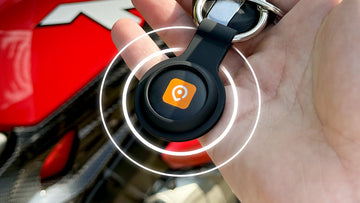

Bluetooth proximity detection: how it works on a motorcycle
Protect my motorcycle with GeoRide Par Thomas
Bluetooth proximity detection lets two devices know they are close to each other, with no GPS and no mobile network: one puts out a short-range radio signal, the other picks it up and works out the distance from it. That is the technology behind the GeoRide 3s disarming protection as your phone comes near, walking you to a motorcycle parked underground, and keeping watch on your garage door with Live Detect.
The essentials
- Bluetooth Low Energy puts out a very low-power radio signal that needs no internet: two devices talk to each other directly, even with zero network coverage.
- The GeoRide 3s uses it to recognize your phone and disarm protection on its own, backed by advanced anti-cloning cryptography.
- In underground parking, where GPS no longer reaches, the 3s Bluetooth radar walks you to the motorcycle ("getting closer / moving away").
- Live Detect applies the same idea to your garage: two sensors in touch with each other, a door opens, an alert lands straight away.
How does Bluetooth proximity detection work?
A transmitter broadcasts a low-power radio signal non-stop, and a receiver measures how strong that signal is to estimate the distance between them: the stronger the signal, the closer the device. That is the whole principle, and it fits in one sentence. Everything after that is refinement.
The modern version of this technology goes by the name Bluetooth Low Energy (BLE). As the name says, it is built to sip power: a sensor can keep transmitting for months, even years, on a tiny battery. Your smartphone speaks it natively, with no exotic accessory or app.
Here is what matters on a motorcycle: the whole conversation stays local. No server, no SIM card, no internet connection. Two Bluetooth devices keep talking in a concrete cellar, an enclosed garage or an apartment block basement, exactly where satellites and the mobile network throw in the towel. Thick walls and obstacles weaken the signal, but that swing in strength is precisely what works as a compass: it tells you whether you are closing in on the transmitter or drifting away from it.
Why does Bluetooth take over where GPS stops?
Because the two technologies play on different ground: GPS needs a view of the sky, Bluetooth only needs another device within range. A GPS tracker will locate your motorcycle hundreds of kilometers away, but it loses the satellites the moment the bike drops one level underground. Proximity detection only reaches a few dozen meters, but it works everywhere, below ground included.
| Feature | GPS / mobile network | Bluetooth proximity detection |
|---|---|---|
| Main use | Long-distance tracking, alerts from anywhere | Immediate close-range locating |
| In underground parking | Signal blocked past the entrance | Works normally |
| Internet connection required | Yes (mobile network) | No, the devices talk directly |
| Range | Worldwide (multi-carrier network) | A few dozen meters |
| Role at GeoRide | Real-time location, alerts, rides | Phone recognition, underground radar, Live Detect |
So the two work hand in hand. A solid anti-theft setup pairs the GPS tracker for keeping an eye from a distance with Bluetooth for meter-level precision once you are standing there. If you want to dig into the satellite side, our full guide to the motorcycle GPS tracker breaks down how real-time location works.
How does the GeoRide 3s recognize your phone?

The GeoRide 3s disarms protection on its own when your authorized phone is close by, then arms itself again after 30 seconds of inactivity. You walk up to your motorcycle, it knows you. You walk off, it goes back on guard. No button, no mandatory fob, nothing to do.
This automatic phone recognition runs on advanced anti-cloning cryptography, inspired by what Tesla uses on its cars: it is designed to stop anyone copying or replaying the signal to pass for you. It works on iOS and on Android, and above all with no internet, since it all happens over Bluetooth between your pocket and the device.
And if your phone is dead? Nothing to lose sleep over: GeoRide stays on guard and the alerts land as soon as it charges up, no event goes missing. The GeoRide proximity fob is still there as an extra for anyone who prefers a dedicated object, but it is not required. That is what makes it a true motorcycle alarm on your phone, without the forgotten activations that leave traditional alarms useless.
Can underground radar really find a motorcycle with no network?

Yes, and that is exactly what it was built for. GPS holds up to the parking entrance; from there, the GeoRide app fires up a Bluetooth radar that sweeps the surroundings and walks you right to the motorcycle, on a "getting closer / moving away" basis. Network or no network: the guidance rides purely on the signal strength between your phone and the device, right where a traditional GPS tracker goes quiet from the first basement level.
Security was in the design from day one. The signal only wakes up when the authorized phone is nearby: a thief cannot use it to sniff out the device or check whether a motorcycle is fitted with one. The GeoRide 3s also carries a smart jamming detection system that spots interference attempts.
When a theft happens, this technology changes the ending in very concrete terms: the police can use radar detection directly, with authorization granted through Theft assistance (available in France), to comb through a parking area where a stolen motorcycle often sits hidden for days. We walk through the whole process in our article on finding a motorcycle underground.
51.7%
of theft attempts end with the theft prevented for riders who have a device fitted: the alert did the job, the motorcycle never moved (2026 GeoRide Motorcycle Theft Report, France).

What does Live Detect pick up in your garage or top case?
Live Detect catches openings: a garage door, the door of an enclosed garage, even a top case or a pannier. It comes in two parts that stay in touch over Bluetooth as long as they are together. The moment they separate, an alert goes straight to your phone. You know before anyone has laid a hand on the motorcycle.
"With Live Detect, your peace of mind takes a real jump. From now on, you know." (Thomas, GeoRide founder)
The accessory is 100% wireless and goes on in 30 seconds, with no tools. It talks to the device over short-range Bluetooth: it has to stay within 10 meters of the GeoRide 3s, and you can pair up to 4 of them with the same device (garage door, gate, gear cupboard and so on). An open/closed status indicator is there in the app whenever you want to check.
The cherry on top: Live Detect can set off Live Alarm on its own, the patented 110 dB smart alarm, as soon as an unauthorized opening is detected. The thief opens the door, the siren screams, and the alert reaches you in real time. That kind of instant reaction is exactly why thieves hate real-time GPS trackers.
Where GeoRide comes in
Bluetooth proximity detection is not one more gadget: it is the piece that completes the GPS tracker where the tracker hits its physical limits. The GeoRide 3s is the only one in the range to carry it, with three uses: automatic phone recognition, radar detection even underground, and compatibility with the Live accessories such as Live Detect (€59) and Live Alarm (€69).
On budget, the 3s comes in at €299 to buy (first month of subscription free, then €5/month with no commitment), or at €14.99/month all in on rental, where rental ships: France, Belgium, Italy and Switzerland. The GeoRide mini offers neither phone recognition nor underground radar: it locates the motorcycle up to the parking entrance, then Theft assistance takes over with the police in France. To pick between the two, our GeoRide mini or GeoRide 3s comparison covers the question. If you park underground or in a shared garage, the 3s is made for you.
Frequently asked questions
Does Bluetooth proximity detection work without internet?
Yes, entirely: the phone and the device talk to each other directly over short-range radio. That is what keeps the GeoRide 3s phone recognition and underground radar running in underground parking with zero network coverage.
Can a thief find my motorcycle through the Bluetooth signal?
No, the GeoRide 3s signal only wakes up when the authorized phone is nearby, so there is nothing to intercept the rest of the time. The anti-cloning cryptography blocks any copy of the signal, and a smart jamming detection system spots interference attempts.
What happens if my phone is dead?
GeoRide stays on guard and nothing gets lost: the alerts land as soon as your phone is charged. In the meantime the motorcycle stays protected, and the GeoRide proximity fob can act as a backup for disarming without a phone.
Does the GeoRide mini have proximity detection?
No, phone recognition, underground radar and the Live accessories are exclusive to the GeoRide 3s. The mini handles real-time location, alerts and ride recording, and locates the motorcycle up to the entrance of underground parking, where Theft assistance takes over in France.
How close does Live Detect have to stay to the device?
Within 10 meters of the GeoRide 3s, the reach of its short-range Bluetooth link. That is plenty to cover a garage door with the motorcycle parked inside, and you can pair up to 4 Live Detect with the same device.
À lire ensuite