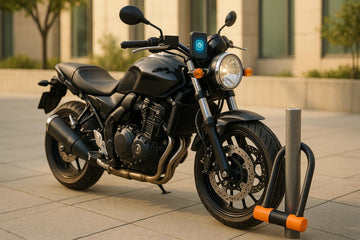

Why motorcycle thieves hate real-time GPS trackers so much
Protect my motorcycle with GeoRide Par Thomas
Thieves hate real-time GPS trackers because they take away the one thing they really need: time. An alert on the first knock, a position sent nonstop, law enforcement guided all the way to the stash spot: the theft is risky from the first second to the last. And it is measured: according to the 2026 GeoRide Motorcycle Theft Report for France, the alert alone is enough to send the thief running in more than half of attempts.
Key takeaways
- A motorcycle theft takes two and a half minutes on average: only an instant alert can keep that pace.
- 51.7% of attempts on motorcycles fitted with GeoRide ended in a theft avoided (2026 GeoRide Theft Report).
- More than nine thefts out of ten are lift-away thefts: the thief never starts the motorcycle, they load it up.
- After 48 hours, the odds of getting your motorcycle back drop by a factor of 10: reacting fast changes everything.
Why does real time change everything for a thief?
Because it takes away their biggest advantage: moving fast, with nobody watching, and vanishing before anyone reacts. A lock or an alarm only gets in the thief's way on the spot. A real-time GPS tracker warns the owner the second the motorcycle moves, then keeps following it wherever it goes. The theft stops being a quiet two-minute job and turns into a race against the clock the thief is no longer sure of winning.
The tracking rate is what makes the difference. A traditional GPS tracker sends one position every 5 minutes, and between two pings a van has already crossed several neighborhoods. GeoRide sends a position every 5 seconds in a straight line, and up to 10 positions per second in corners, with accuracy that drops below a meter thanks to Galileo. On the map, your motorcycle does not jump from dot to dot: you follow it like a thread.
And there is a sneakier effect for the thief: doubt. A GPS tracker fitted properly is invisible from the outside. Before making a move, there is no way of knowing whether the bike they are eyeing is silent or already lighting up its owner's phone. For the full picture on how these devices work, our complete guide to motorcycle GPS trackers covers everything.
How do thieves actually work?
In more than nine cases out of ten, the bike is lifted away, according to the Mutuelle des Motards, a French motorcycle insurer, and to tracking providers: the thief never starts the motorcycle. Several of them pick it up, break the steering lock, load it into a van, and the job is done in two and a half minutes on average. With nothing securing it to a fixed point, it can take less than a minute.
The next step is less well known: the bike is not resold right away. It goes to a stash spot, where the thief waits to see whether it is connected. That window is exactly what lets a tracker turn the tables, and we come back to it below.
The scale of it explains why thieves are organized: 15,975 two-wheeler thefts were reported and paid out in France in 2025 according to France's GIE Argos, and the real estimate climbs to 55,000 to 60,000 a year, one two-wheeler every 10 minutes. Around half of thefts happen in places people think of as safe: shared garages, basements under apartment blocks. And targets are not picked at random: according to the 2026 GeoRide Theft Report, 73% of the motorcycles hit are Yamahas, BMWs or Hondas.
Nothing to panic about here: knowing the standard playbook is mostly what tells you where to act. We have also broken down the theft techniques used most often and how to protect yourself from them.
Why don't traditional locks scare them anymore?
Because they give way in seconds and warn nobody. Against a modern battery-powered angle grinder, an approved U-lock takes about fifteen seconds per cut. The thickest chain only adds a little to the bill. A lock anchored to a fixed point still does a real job: it makes the lift-away harder and forces the thief to make noise. But it is no substitute for a real-time alert.
Audible alarms assume somebody hears them and reacts. That is exactly what happened to Thomas, the founder of GeoRide, whose motorcycle was stolen in 2017 on the morning he was setting off on a road trip: a lock attached to a fixed point and an alarmed disc lock, all cut through. He lived two floors up and heard nothing.
"It drove me crazy that we were using sound to warn about a problem when we all have a phone in our pocket." (Thomas, GeoRide founder)
Here is what each kind of protection really puts in a thief's way:
| Against the thief | Physical lock | Audible alarm | Real-time GPS tracker |
|---|---|---|---|
| Neutralization | About fifteen seconds per cut with an angle grinder | Ignored or ripped off in seconds | Hidden device, built-in backup battery |
| Warning the owner | None | Sound only, short range | Instant, on your phone, wherever you are |
| Once the bike is lifted away | No protection left | No protection left | Position followed nonstop, police guided |
| What it really does | Slow them down, force noise | Raise the alarm on the spot | Deter, alert, recover |
The right strategy does not pit these protections against each other: it combines them, with real time as the safety net.
Does real-time deterrence actually work?
Yes, and this is not a marketing promise, it is a measurement: in 51.7% of the attempts logged by the 2026 GeoRide Theft Report, the alert was enough and the motorcycle was never even moved. One bike in two is a theft that simply never happens.
51.7%
of theft attempts on motorcycles fitted with GeoRide stopped before the bike moved: 199 thefts avoided out of 385 alerts analyzed (2026 GeoRide Motorcycle Theft Report for France).
That figure comes from a survey of more than 4,600 GeoRide users run between December 2025 and March 2026, including 385 riders who went through an attempt or an actual theft. You can read the full study in our big survey on motorcycle theft in France.
The mechanism is simple: the thief sets off noise, a light going on at a neighbor's window, or just the feeling that somebody knows. Their math changes instantly and they move on. And the owner never has to step into danger: knowing the bike will be located means you can act calmly, with no confrontation.
"The idea with GeoRide is to act when it is an emergency, and to be relaxed the rest of the time." (Thomas, GeoRide founder)

What if your bike gets taken anyway?
The game is not over, it is just starting: the tracker keeps transmitting, and every minute works for you. Even with the wires ripped out, the GeoRide device runs on its built-in battery for hundreds of kilometers. The van can drive all it wants, the position follows.
Remember how they operate: the bike goes to a stash spot first, long enough to check whether it is connected. That is exactly where the tracker turns the tables. GeoRide Theft assistance, available 24/7 in mainland France and included in the subscription, calls you back in under 5 minutes and coordinates directly with law enforcement: they get the real-time position through a simple web link, with no app to install. Catching them red-handed at the stash spot becomes possible.
How fast you react decides everything: after 48 hours, the odds of recovery drop by a factor of 10 according to law enforcement data. So trigger Theft assistance the moment you notice the theft, and know the right moves: we go through them in what to do in the first 5 minutes after a theft.
The contrast with an unequipped bike is brutal: across France, only 24.3% of stolen two-wheelers are recovered (2025 Argos Barometer), so 3 motorcycles out of 4 are gone for good. With a real-time tracker, the vast majority of bikes that do get moved are found again. Even in underground parking the hunt keeps going: we explain how GeoRide locates a motorcycle underground.
Where GeoRide comes in
GeoRide launched its first connected solution in 2018 with a simple idea: swap sound that goes nowhere for the phone you always have on you. The GeoRide 3s alerts you on the first knock through 4 channels of your choice: push notification, phone call, email, and even the iOS critical alert that rings at full volume in Do Not Disturb. It adds Radar detection even underground, Automatic phone recognition and a smart jamming detection system.
To push deterrence further, the Live Alarm adds a patented 110 dB siren you can trigger remotely, from anywhere, to send a thief running mid-job. And if you want the essentials of protection at a smaller price, the comparison GeoRide mini or GeoRide 3s helps you choose. Either way, installation takes 5 minutes, and where rental is available it starts at €9.99 a month with no commitment.
Frequently asked questions
Can a thief neutralize a GPS tracker?
It is very hard: the device is hidden on the motorcycle and keeps running on its built-in battery for hundreds of kilometers, even with the wires ripped out. If the power is disconnected, you get an immediate alert. The GeoRide 3s adds an alert if the mount is pulled off, plus a smart jamming detection system.
What should you do when a theft alert lands on your phone?
Never take on the thief by yourself: it achieves nothing and puts you at risk. Trigger Theft assistance in the GeoRide app: available 24/7 in mainland France, it calls you back in under 5 minutes and coordinates the response with law enforcement, real-time position in hand.
Does a GPS tracker work in underground parking?
Yes, with the right kit: GPS works up to the parking entrance, then the GeoRide 3s switches on a Bluetooth radar detection that guides you right to the bike, with or without a network, and the police can use it directly after a theft. With the GeoRide mini, tracking stops at the parking entrance and Theft assistance takes over with law enforcement.
Can a GPS tracker lower my motorcycle insurance?
Yes, a GPS tracker can bring down the premium or the deductible with some insurers. Terms vary from one company to the next, so the simplest move is to tell your insurer about the equipment and ask what they offer for motorcycles fitted with a real-time tracker.
À lire ensuite