
Motorcycle GPS Tracker: How It Works and How to Choose One
Protect my motorcycle with GeoRide Par Thomas
A motorcycle GPS tracker is a discreet device, wired to your battery, that locates your machine in real time and alerts you at the slightest suspicious movement. To pick the right one, four things really matter: how often it reports a position, how it is powered, its network coverage, and the services that take over once the alert goes off. Here is how it works, and how to find the model that suits the way you ride.
The essentials
- A GPS tracker combines a GPS chip, a multi-carrier SIM card and an app: real-time position and instant alerts on your phone.
- In France, a motorcycle or scooter is stolen every 10 minutes according to Argos and the Mutuelle des Motards, and only 24.3% are recovered without a tracker.
- The immediate alert changes everything: in 51.7% of attempts, the theft is simply avoided (2026 GeoRide Motorcycle Theft Report, France).
- Two models at GeoRide: the 3s, the most complete, and the mini, the essentials, to buy from €199, then €5/month with no commitment.
How does a motorcycle GPS tracker work?
A motorcycle GPS tracker brings together three parts: a satellite receiver that works out where the bike is, a SIM card that sends that position over the mobile network, and an app that shows it to you and raises the alert. You will also see it called a GPS tracking device, or simply a tracker: it is exactly the same thing. The device hides on the bike, wires into the battery, then gets on with the job on its own, 24/7.
The real difference between the options on the market comes down to how often positions are sent. A standard GPS tracking device drops one point every 5 minutes. GeoRide sends up to 10 positions per second through a corner, one every 5 seconds on a straight line, with accuracy that drops below a meter thanks to Galileo. In practice: on the map you watch your bike move live, not a position that is several minutes old.
There is another key point: the device lives its own life without depending on your smartphone.
"GeoRide is completely independent of the phone."
Thomas, GeoRide founder
Your phone can be switched off, dead or sitting at home: the device keeps watch over the bike and the alerts go out anyway. A built-in backup battery takes over if the power is cut, and the multi-carrier network covers more than 200 countries, automatically picking the most reliable carrier in the area.
What difference does a GPS tracker make in a theft?
It turns a silent theft into an immediate alert, and that is exactly what makes thieves fail. According to the Mutuelle des Motards, the French riders' insurance mutual, and geolocation operators, 90 to 95% of motorcycle thefts are lift-away thefts: thieves never start the machine, they pick it up, break the steering lock and load it into a van, heading for a stash house. With no witness and no alert, the whole thing is over in a few minutes.
Without a tracker, the outcome is brutal: according to the 2025 Argos report, only 24.3% of stolen motorcycles and scooters are recovered. Three bikes out of four are gone for good. And time works against you: after 48 hours, the chances of getting the bike back are divided by 10, according to law enforcement data.
With a real-time tracker, the script flips. The alert lands at the first jolt, often before the bike has even left the street. The 2026 GeoRide Motorcycle Theft Report in France, based on more than 4,600 riders, measured the effect:
51.7%
of theft attempts stopped in their tracks: the GeoRide alert was enough, the bike was not even moved (2026 GeoRide Theft Report, 199 bikes out of 385 theft alerts).
One bike in two: a theft that never happened. And when the bike really is moved, the vast majority come back: the real-time position goes to the police, who can step in and even catch them in the act. You, meanwhile, stay out of harm's way. You never take on a thief yourself, and knowing the bike is being tracked lets you act calmly, without putting yourself at risk.

GPS tracker or physical lock: do you have to choose?
No, the two work together, but they are not playing the same game at all. A U-lock, even a top-of-the-range one, gives way in about 15 seconds per cut to a modern battery-powered angle grinder. Its reputation for "several minutes of resistance" comes from the certification tests, which are carried out with a hand saw, and nobody steals a motorcycle with a hand saw.
The physical lock is still worth having: anchored to a fixed point, it stops a quick lift-away and forces the thief to make noise. What it will never do is warn you. By the time you find the chain cut at dawn, the bike has been on the road for hours and the window to act has closed.
The GPS tracker adds exactly the missing piece: information in real time. So the right strategy pairs a physical anchor point that slows things down and makes noise with a tracker that alerts you and locates the bike if the thief goes ahead anyway. We go into that pairing in our comparison of GPS tracker vs physical lock.
Which criteria really matter when choosing a motorcycle GPS tracker?
Four criteria make the real difference between models: position frequency, power supply, network coverage and the services behind the alert.
Position frequency. One point every 5 minutes is fine for finding a trailer, not for following a bike being ridden away through a city. Aim for real time. Rule out Bluetooth tags like the AirTag too: they rely on phones passing nearby and are not built for motorcycle security.
Power supply. A device wired to your bike's battery never has a cell to recharge, and a solid built-in backup battery has to take over if the cables are ripped out: GeoRide's lasts for hundreds of kilometers.
Network coverage. A single-carrier tracker goes quiet in its network's dead zones. A multi-carrier network that switches automatically to the most reliable signal in the area, in more than 200 countries, follows you deep into the valleys and across borders.
The services after the alert. This is the criterion everyone forgets. A notification at 3am is no use if you are on your own to deal with it. At GeoRide, Theft assistance answers 24/7 in mainland France, calls you back in under 5 minutes and coordinates directly with law enforcement. Think about underground parking too, the weak spot of GPS: we explain how to locate your motorcycle underground.
GeoRide 3s or GeoRide mini: which model is for you?
The GeoRide 3s is the most complete model, the GeoRide mini covers the essentials at a gentler price. Both share the heart of the service: real-time location, instant alerts, automatic ride recording, fall detection with your loved ones alerted automatically, free lifetime updates, plus emergency call and theft assistance in France.
| What matters | GeoRide 3s | GeoRide mini |
|---|---|---|
| Purchase | €299 (then €5/month, first month free) | €199 (then €5/month, first month free) |
| All-inclusive rental, no commitment (France, Belgium, Italy and Switzerland only) | €14.99/month | €9.99/month |
| Real-time location and alerts | Yes | Yes |
| Fall detection and emergency call | Yes | Yes |
| Automatic phone recognition | Yes | No |
| Radar detection even underground | Yes | No (location up to the parking entrance) |
| Lean angle recording in corners | Yes | No |
| Live accessories (Alarm, Detect, Wheel) | Yes | No |
| Detached-mount and high-temperature alerts | Yes | No |
| Vehicle with no battery (USB charging) | Yes (9 to 18 V) | No (10 to 30 V, battery required) |
Go for the 3s if your bike sleeps in underground parking (radar detection guides you all the way to it even with no network), if you want the automatic phone recognition that disarms protection as you walk up, or if your vehicle has no battery. The mini is perfect for covering the essentials on a scooter or a bike that sleeps in the street, without breaking the bank. For the full detail, we have given the GeoRide mini vs GeoRide 3s match-up an article of its own.
On price, rental (France, Belgium, Italy and Switzerland only) rolls the subscription into the monthly fee, with a lifetime hardware warranty and, if the stolen bike is not recovered, a new GeoRide sent free of charge. If you buy, budget €5/month with no commitment after the first free month; buying works out better than renting after around 2 years.
How do you install a GPS tracker on a motorcycle?
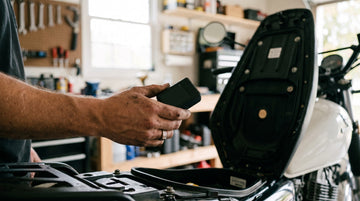
In 5 minutes, with two wires: red to the battery "+" terminal, black to the "−" terminal, nothing else to connect. No need to book a slot at a dealer, and installing it has no impact on your motorcycle's manufacturer warranty. Our step-by-step guide to installing a GPS tracker on your motorcycle walks through every stage.
Then it is about placing the device well: discreet, out of sight, but easy for you to reach. Under the seat, behind a side panel, there is no shortage of options, and we have listed the best hiding spots for a GPS tracker.
One worry comes up again and again: power draw. A good tracker uses very little, with a smart sleep mode when the bike is parked. The bike starts normally, even after several weeks without a ride.
Where GeoRide comes in
GeoRide launched its first connected device in 2018 with one simple conviction: everybody makes GPS trackers, it is the app that makes a good product. More than 30,000 riders are protected today, and the device does more than keep watch: it records every ride automatically, with the exact route, the weather, the altitude and the towns you pass through, ready to relive as a 3D ride replay in the GeoRide app. The GeoRide 3s and the GeoRide mini are available to buy or, in France, Belgium, Italy and Switzerland only, to rent with no commitment.
Protection goes beyond theft, too: fall detection alerts your loved ones automatically after an accident, even if your phone is out of action, and in France it calls the emergency services in under 2 minutes. And to sharpen the deterrence, the Live Alarm adds a patented 110 dB siren you can set off remotely from the app, wherever you are. Curious to see the app before kitting out the bike? Demo mode lets you try everything freely, without being a customer.
FAQ
What is the difference between a motorcycle GPS tracker and a standard GPS tracking device?
Position frequency: a standard GPS tracking device sends one point every 5 minutes, where GeoRide sends up to 10 positions per second through a corner. During a theft, a position that is 5 minutes old means a bike already several kilometers away; real time lets the police follow the vehicle live.
Does a GPS tracker work in underground parking?
GPS stops at the parking entrance, but the GeoRide 3s takes over with its radar detection even underground: precise Bluetooth guidance leads you to the bike with no network at all, and the police can use it if the bike is stolen. With the GeoRide mini, you get the last known position at the parking entrance, then theft assistance, available in France, takes over with law enforcement.
Does a GPS tracker drain your bike's battery?
No, the power draw is very low and the bike starts every time, even after a long spell standing still. The device only sends positions when it makes sense and drops into smart sleep when parked. Its built-in backup battery stays ready at all times.
What happens if thieves rip out the tracker's cables?
The tracker keeps running on its built-in battery, for hundreds of kilometers in GeoRide's case. You get a "Power disconnected" alert straight away, and on the GeoRide 3s a second alert fires if the device itself is pulled off its mount.
Can a GPS tracker lower my motorcycle insurance?
Yes, a GPS tracker can bring down the premium or the excess with some insurers. Conditions vary from one company to the next: the simplest move is to tell your insurer about the equipment and ask what your policy allows for.
À lire ensuite