
GPS Tracker vs Physical Lock: What Really Protects Your Bike?
Protect my motorcycle with GeoRide Par Thomas
A physical lock and a GPS tracker do two very different jobs. The lock buys you a few seconds and makes a thief think twice about your bike. The tracker tells you the moment it moves and gives you something to act on. When a theft takes under three minutes, the real-time alert is what changes the outcome. The best setup: run both, once you know exactly what each one brings.
The short version
- Put a cordless angle grinder against a certified U-lock and it gives way in about fifteen seconds per cut: it deters, it does not stop anyone.
- 90 to 95% of thefts are lift-away thefts: the bike gets picked up and loaded into a truck, locks and all.
- A GPS tracker raises the alarm while it is happening: according to the 2026 GeoRide Theft Report, more than one attempt in two fails on the alert alone.
- The strongest setup pairs an anchored physical barrier with a connected alert.
What does a physical lock actually protect you from?
A physical lock mostly protects you from the opportunist: it makes your bike slower, louder and riskier to take. That counts for a lot, insurers often demand it, and it is still the first thing you do when you park.
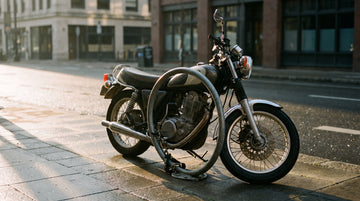
Each type has its job. The U-lock strikes a good balance between weight and resistance. The chain lets you secure the bike to a fixed point, and that matters more than anything: with nothing to anchor it to, under a minute is enough to walk a machine away, when the average theft runs about 2 minutes 30 seconds. The disc lock, light and quick to clip on, does the job for short stops.
These setups need no battery, no network and no subscription. But they all share one blind spot: none of them tells you when someone is having a go at your bike. While it is happening, you are asleep, at work, somewhere else. And plenty of riders make that silence worse with bad parking habits: we listed the main ones in the 10 mistakes that still make motorcycle theft easy.
How long does a lock last against an angle grinder?
About fifteen seconds per cut: that is all a modern cordless angle grinder needs to get through a certified U-lock. The famous "2 minutes of resistance" you read everywhere comes from the certification test, run with a hand saw. Put the tools thieves actually carry against it and the stopwatch tells a very different story.
So is the lock useless? No. Cutting makes noise, throws sparks and forces the thief to stand there in plain sight. A lock anchored to a fixed point also rules out the quick lift and carry. But let us be honest: in fifteen seconds nobody has time to get downstairs, and that is assuming you heard anything at all.
That is exactly the gap thieves work in, with well-rehearsed methods we break down in the most common theft techniques.
How do thieves get a bike away with the locks still on?
In 90 to 95% of cases the bike never starts: it is lifted and loaded into a truck, locks included (Mutuelle des Motards, the French riders' insurer). The method barely changes: the thief leaves the ignition alone, breaks the steering lock, a few of them lift the machine and it vanishes into a van. It then sits in a stash spot while they check whether it is connected.
The scale is real: 15,975 two-wheeler thefts declared and paid out in 2025 according to GIE Argos, the French insurers' stolen-vehicle body, with a realistic estimate of 55,000 to 60,000 thefts a year, or one two-wheeler every 10 minutes. More surprising still: around half of thefts happen in places people think are safe, shared garages and residential basements first among them.
Time is the deciding factor. Past 48 hours, your chances of getting the bike back drop by a factor of 10. Every minute you save between the attempt and your reaction counts, and we boiled down the right moves in what to do in the first 5 minutes after a theft.
What does a GPS tracker change while your bike is parked?
It changes when you find out: during the attempt, not the next morning in front of an empty space. The moment a vibration or a suspicious movement is picked up, GeoRide alerts you on whichever channel you pick: push notification, email, phone call, or the iOS critical alert that rings at full volume even on Do Not Disturb. And if the wires get ripped out, the device's built-in battery takes over for hundreds of kilometers.
That is the whole point of the video above: in Germany, Thomas comes across a BMW GS locked down with three locks, disc locks, a U-lock and a chain.
"There is an easier way than going to the trouble of fitting three locks: you install the GeoRide app. If anything at all happens, your phone rings straight away. At least you can sleep easy." (Thomas, GeoRide founder)
And this is not just a promise of peace of mind, it has been measured. The 2026 GeoRide Motorcycle Theft Report (France), based on more than 4,600 riders, shows that the alert on its own is very often enough to send the thief running before the bike has moved at all. So a GPS tracker is not only a recovery tool, it is a deterrent first, and it keeps you out of any confrontation: you never have to play hero, the alert does the work and Theft Assistance takes it from there in France.
51.7%
of theft attempts stopped by the alert alone: the bike was not even moved (2026 GeoRide Motorcycle Theft Report, France).

Physical lock or GPS tracker: what does each one actually do?
These two are not in the same league: one delays and deters on the spot, the other alerts, locates and gets the police involved. The table below sums up what each one really gives you while the bike is parked.
| Criterion | Physical lock (U-lock, chain, disc lock) | Connected GPS tracker (GeoRide) |
|---|---|---|
| Main job | Slow the thief down, deter him on sight | Alert in real time, locate, coordinate the response |
| Alert during the attempt | None (apart from alarmed models, audible at short range) | Immediate: phone call, notification, email, iOS critical alert |
| Against an angle grinder | About fifteen seconds per cut | The first vibration sets off the alert |
| Against being lifted into a truck | Only useful if the bike is secured to a fixed point | The bike stays located in real time, even once it is moved |
| In underground parking | No way to see anything from a distance | GeoRide 3s: Radar detection even underground, precise guidance |
| If the bike goes anyway | No help getting it back | Position passed to the police, 24/7 Theft Assistance in France |
| Day-to-day hassle | Handling it at every stop, weight to carry | Fitted once in 5 minutes, automatic disarming (3s) |
| Budget | One-time purchase, depending on the range | Purchase from €199, then €5/month with no commitment |
Let us stay honest: the lock keeps advantages the tracker will never have. It is visible, it depends on no network, and your insurance policy often demands it. But on getting the bike back, the national figures leave no room for debate: the French recovery rate for stolen two-wheelers tops out at 24.3% (Argos Barometer 2025). Three bikes out of four never come home. With a GPS tracker, the vast majority of bikes that really do get moved are found.
So do you choose, or run both?
Run both: that is the strongest play, because each one covers a gap the other leaves open. A chain anchored to a fixed point forces the thief to make noise and to spend time on it. The tracker turns that time into your advantage: the alert goes out on the first jolt, before the first cut is even finished.
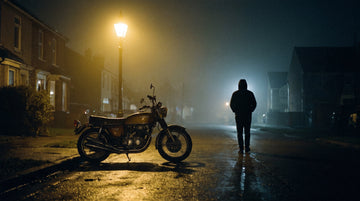
In practice, a typical night with both: the bike is chained up, the thief starts on the chain, your phone rings within the second. More than half the time the story ends right there and the thief bolts. If he loads the bike into a truck anyway, it keeps sending its position, and Theft Assistance, available in mainland France, coordinates the response with law enforcement. Even parked in a residential basement, the protection carries on: we explain how in our article on underground location tracking.
The smart way to spend your money: instead of stacking a third lock on the front wheel, keep one good anchored lock and put the difference into a real-time alert. It is the pairing of a physical barrier and a GPS tracker that makes thieves back off, not more steel.
Where GeoRide fits in
GeoRide is exactly the link physical locks are missing: the alert and the location. The GeoRide 3s picks up vibration, movement and power cuts, alerts you in real time, disarms itself as your phone gets close, and adds Radar detection even underground for residential parking. The GeoRide mini gives you the essentials of that protection from €9.99/month on rental, with no commitment, in the countries rental ships to: France, Belgium, Italy and Switzerland.
When a serious alert comes in, you are never on your own: Theft Assistance, included in the subscription, is available 24/7 in mainland France, calls you back in under 5 minutes and passes your bike's position to the police in real time. And to add audible deterrence without hauling an alarmed disc lock around, the Live Alarm (110 dB, compatible with GeoRide 3 and 3s) goes off on its own, or remotely from the app, wherever you happen to be. Every offer, purchase and rental alike, is laid out on the dedicated page.
FAQ
Does a GPS tracker replace the lock my insurer requires?
No: if your policy calls for a certified physical lock, that lock stays mandatory and the tracker comes on top. Good news though, a GPS tracker can bring down your premium or your deductible with some insurers. Check the exact wording of your policy before you buy your kit.
Does a GPS tracker work in underground parking?
Yes, as long as you pick the right kit. Standard GPS gives up at the entrance ramp, but the GeoRide 3s takes over with Radar detection even underground, guiding you straight to your bike with no network at all. With a GeoRide mini you get the last known position at the entrance, and Theft Assistance, available in mainland France, takes it from there with the police.
What should you do when a Theft alert goes off?
Never go after the thief on your own, you would be putting yourself in danger for nothing. Trigger Theft Assistance in the GeoRide app, available 24/7 in mainland France: you get a call back in under 5 minutes and the team coordinates directly with law enforcement, with your real-time position to back it up.
Does the device still work if thieves cut the power?
Yes: the built-in battery takes over immediately and the device keeps running for hundreds of kilometers. You also get a dedicated alert the moment the power is disconnected, which is a theft attempt signal in itself.
À lire ensuite