
Locking your motorcycle to a fixed point: why it's so hard in practice
 Par Thomas
Locking your motorcycle to a fixed point is still the number one piece of advice from lock manufacturers, and the reasoning behind it is sound: the vast majority of thefts are lift-away thefts. The problem is the street itself. Out there, a U-lock almost never fits around anything the city has bolted down, and a chain long enough to do the job costs you in weight and scratched wheels. The realistic answer: something solid to lock to when you can find it, and a real-time alert in every case.
The essentials
- The fixed-point advice is well founded: 90 to 95% of motorcycle and scooter thefts are lift-away thefts, according to Mutuelle des Motards, a French motorcycle insurer.
- In practice, a U-lock rarely goes around a post or a stand, and a chain long enough to reach one is heavy to carry on every ride.
- Against a cordless angle grinder, even an approved U-lock gives way in about 15 seconds per cut: a fixed point slows a thief down, it doesn't warn you.
- A GPS tracker like GeoRide is fitted once and for all and alerts you straight away: according to the 2026 GeoRide Theft Report, one alert in two is enough to make the theft fail.
Why does everyone tell you to lock your motorcycle to a fixed point?
Because that advice answers the method thieves actually use: 90 to 95% of motorcycle and scooter thefts are lift-away thefts, according to Mutuelle des Motards and geolocation operators. The thief isn't trying to start your motorcycle. A team of them lifts it, snaps the steering lock, loads it into a van, then stashes it somewhere quiet to see whether it's carrying a tracker.
Against that scenario, securing the bike to something fixed makes sense: it stops them picking it up as it stands and forces the thief to cut through something, which means noise and lost time. In principle, the lock manufacturers are right. It's putting it into practice that falls apart, and that's exactly what Thomas's video is about. For the full picture of the protections that work together, our guide to protecting your motorcycle from theft effectively covers the basics.
Why is this advice so hard to follow on a real street?
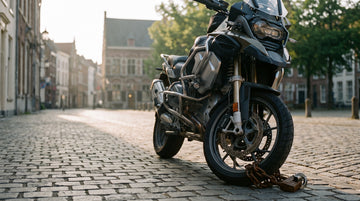
Because street furniture was never designed around your locks. Posts are too thick for a U-lock's shackle, railings too tall or too wide, and stands made for motorcycles and scooters are still rare in most cities. So you end up circling your parking spot, lock in hand, with nothing to hook it onto.
"Show me how you're meant to lock that to a fixed point. It doesn't even go around the fixed point, actually." (Thomas, GeoRide founder)
And a fixed point doesn't solve everything, even where there is one. Around half of all thefts happen in places that feel safe, shared garages and residential basements first among them, exactly where there's usually nothing to lock to. The advice is good on paper. In real life it depends on something you don't control: whatever the city decided to put next to your parking spot.
Does a chain lock really solve the problem?
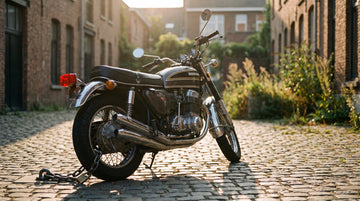
Only partly: it loops around things a U-lock can't, but it brings its own daily grind. A chain long enough to go around a post and through your wheel is heavy, and you have to carry it on every ride. Strapped to the bike, it rubs and marks the wheels. In a backpack, your back pays for it. Thomas puts it bluntly in the video: you'll have your hands full, and your wheels won't thank you.
A chain locked to a fixed point is still a real barrier against lift-away theft, and that's why it keeps its place in an anti-theft setup, especially at home where it can stay put. We go through that logic in our article on why a chain lock and a GPS tracker work well together. The question isn't chain or no chain, it's this: what happens while someone is going at your lock, and who tells you about it?
How does an approved U-lock hold up against a cordless angle grinder?
Against a modern cordless angle grinder, even an approved U-lock gives way in about 15 seconds per cut. That's not a flaw in these locks, which are still a serious benchmark among physical locks: the official approval test is simply run with a hand saw, a tool that has nothing to do with what thieves carry today. The famous "2 minutes of resistance" comes from that protocol, not from the street.
Real-world figures confirm the gap: motorcycle insurance professionals put the average theft at 2 minutes 30 seconds, and at under a minute when the bike isn't locked to a fixed point. Put another way, a physical lock buys you precious seconds, never a whole night. And if nobody is alerted during those seconds, they're worth nothing. To dig deeper, read our analysis: is an approved motorcycle lock really better?

Physical lock or GPS tracker: do you really have to choose?
No, the two don't play in the same league: one slows the thief down, the other warns you and lets you act. A GPS tracker blocks nothing physically, but it completely changes what happens next. According to the 2026 GeoRide Theft Report on motorcycle theft in France, in 51.7% of attempts the alert was enough on its own: the bike was never even moved. One motorcycle in two, that's a theft avoided. And without a tracker, the 2025 Argos barometer, from the French insurers' body that tracks stolen vehicles, puts the recovery rate for stolen motorcycles and scooters in France at 24.3%: three bikes out of four gone for good.
| Solution | Locking to a fixed point | Everyday use | Against lift-away theft | The limit |
|---|---|---|---|---|
| U-lock on its own | Rarely possible, the shackle is too short for most posts | Compact, but you carry it at every stop | Weak with nothing to lock to: the bike gets lifted with the U-lock still on | Nobody is warned while it's being cut |
| Chain + fixed point | Yes, when there's something solid to lock to | Heavy to lug around, rubs against the wheels | A solid physical barrier, forces noise and time | Gives way to an angle grinder too, with no alert |
| GeoRide GPS tracker | No fixed point needed | Fitted once, nothing to carry | Instant alert, real-time location, Theft assistance | Doesn't physically block the motorcycle |
The honest answer is that they work together: a physical lock when the spot allows it, and a real-time alert everywhere, all the time. We gave that face-off a full comparison: GPS tracker or physical lock, which one should you choose for your motorcycle?
What GeoRide brings to this
GeoRide takes the problem from the other end: instead of depending on street furniture, the protection lives inside the motorcycle. The device fits in 5 minutes, two wires to the battery, and after that there's nothing to carry, nothing to lock, nothing to forget.
"You fit it once and you never think about it again." (Thomas, GeoRide founder)
At the slightest suspicious movement, you know about it straight away: push notification, phone call, email, right through to the iOS critical alert that rings even in Do Not Disturb. You follow your motorcycle in real time, with up to 10 positions per second through corners, where a conventional GPS tracker sends one point every 5 minutes. And if the theft happens anyway, Theft assistance, included in the subscription, calls you back in under 5 minutes, 24/7 in mainland France, and coordinates the search with law enforcement. The rest of the time, the same device records your rides and lets you replay them in 3D in the app.
On budget, the GeoRide mini GPS tracker rents for €9.99/month with no commitment and the GeoRide 3s for €14.99/month, with rental shipping to France, Belgium, Italy and Switzerland. To buy, prices start at €199 with a €5/month subscription, first month free. Cheaper than some top-end chains, and your wheels stay unmarked.
FAQ
Should you drop the physical lock if you have a GPS tracker?
No, the two protections work together: a lock secured to a fixed point slows the thief down and forces them to make noise, the tracker alerts you and lets you locate the bike. The ideal setup is a chain that stays put at home, a portable lock when the spot allows it, and a GPS tracker running at all times.
Do motorcycle insurers require an approved lock?
Some insurers do require an approved lock to cover theft, especially on recent or powerful motorcycles: check your policy. A GPS tracker can also bring down your premium or your excess with some insurers.
How long does a motorcycle theft take on average?
About 2 minutes 30 seconds, according to estimates from motorcycle insurance professionals, and under a minute when the bike isn't locked to a fixed point. That's why how fast the alert reaches you matters as much as how tough the lock is.
What should you do if your motorcycle is stolen anyway?
Never take on a thief on your own: trigger Theft assistance in the GeoRide app, available 24/7 in mainland France, which calls you back in under 5 minutes and passes the real-time location to the police. We go through every step in our article on the first 5 minutes after a motorcycle theft.
À lire ensuite