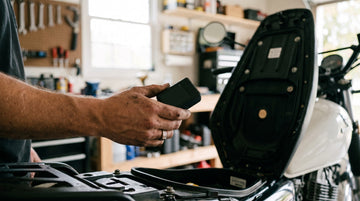

Where to hide a GPS tracker on your motorcycle: the best spots
Protect my motorcycle with GeoRide Par Thomas
The best place to hide a GPS tracker on a motorcycle is the one a thief can't search through in a few seconds: behind a fairing, around the electrical box or under the fuel tank, never just sitting under the seat. A good hiding spot ticks four boxes: real discretion, decent GPS signal, protection from water and vibration, and access for maintenance.
Key takeaways
- Under the seat is the first place a thief looks: a Bluetooth tag gets spotted there in seconds.
- The best hiding spots mean taking something apart: side fairing, battery surround, underside of the fuel tank.
- Plastic lets the GPS signal through, big metal masses weaken it.
- The hiding spot isn't everything: it's the real-time alert, from the very first tilt, that sends the thief running.
Why does your GPS tracker's hiding spot change everything?
Because 90 to 95% of motorcycle thefts are lift-away thefts, according to French motorcycle insurer Mutuelle des Motards: the thief doesn't start your motorcycle, they lift it, break the steering lock and load it into a van. Then they leave it in a stash for a while, long enough to check whether it's connected. That's where everything is decided: the bike gets inspected, and a device left in plain sight is ripped out in seconds.
A well-hidden GPS tracker, on the other hand, keeps transmitting through that whole phase. Every minute it stays in place is a minute when the motorcycle's position is known, transmitted and usable by the police. That's exactly why thieves hate real-time GPS trackers: their whole method runs on staying unnoticed, and a device they can't find takes that away.
The other issue is speed. A motorcycle theft takes 2 minutes 30 seconds on average, and less than a minute when the bike isn't secured to a fixed point. You'll never have time to get downstairs: what counts is being warned at the first movement, then letting the device do its job somewhere nobody will find it.
51.7%
of the theft attempts logged by the 2026 GeoRide Motorcycle Theft Report in France stopped in their tracks: the alert was enough, the motorcycle wasn't even moved.
Is an AirTag under the seat enough to protect your motorcycle?
No, and it's probably the most common mistake riders make. Thomas, the founder of GeoRide, sees it all the time:
"You get a lot of riders sticking an AirTag under the seat, and they think that's it, they're covered."
The problem is twofold. First, an AirTag has built-in protection against people being tracked, and here it works against you: after a few minutes, the thief's iPhone pops up a notification of its own accord, telling them an unknown AirTag is moving with them. They go looking, find it under the seat, throw it away. Second, a Bluetooth tag depends on nearby phones to report a position: inside a closed van or an isolated stash, it reports nothing, and it never alerts you when the bike moves. It was simply never designed to protect a motorcycle from theft.
Thomas puts it bluntly:
"You stash the tracker deep inside your bike, somewhere nobody is going to look without stripping the whole thing down."
A dedicated GPS tracker ticks the boxes a Bluetooth tag misses: a silent alert on your phone the moment the bike leans a few degrees, real-time location wherever it ends up, and no notification that tips off the thief. Hiding an AirTag in the right spot won't turn it into an anti-theft device: the location matters, but the tool comes first. It's one of the classic mistakes that still make motorcycle theft easy.
What makes a good hiding spot?
A good hiding spot brings four qualities together: invisible without dismantling, transparent to the GPS signal, protected from water and vibration, and reachable for maintenance. None of the four should be sacrificed for the other three.
Discretion first. Thieves know the obvious spots by heart. Your goal: make the search long and technical. If getting to the device means pulling out tools and removing a fairing, a thief in a hurry gives up first.
The GPS signal next. The device needs to see the sky, at least through plastic. Fairings, side panels and composite parts don't get in the way of reception; big metal masses (fuel tank, engine block) weaken it. Sometimes moving the device a few centimeters transforms reception.
Physical protection. A motorcycle lives outdoors: rain, washing, spray, vibration, temperature swings. Pick an area naturally sheltered from water spray, away from direct engine heat, and fix the device down firmly so it doesn't wander around while you ride.
Accessibility last. A tracker wired to the battery is easy to forget about, but you will need to get to it one day, for a check or when you change motorcycles. Ideally: a spot you can reach with a screwdriver or an Allen key, without stripping the whole bike. The full wiring detail is in our guide to installing a GPS tracker on your motorcycle.
What are the best places to hide a GPS tracker on a motorcycle?
The best places are the ones you have to take something apart to find: behind a side fairing, around the battery and the electrical box, or under the fuel tank. Here is how the five classic areas compare:
| Location | Discretion | GPS signal | Worth knowing |
|---|---|---|---|
| Behind a side or front fairing | Very good | Very good (plastic) | Needs the fairing removed, the best option on most motorcycles |
| Around the battery or the electrical box | Good | Decent | Shortest possible wiring run, device buried among the looms and relays |
| Under the fuel tank or in a recess in the frame | Excellent | Variable | The metal around it can get in the way of reception: test before you close it up |
| Under the seat | Poor | Good | First place searched; only acceptable if the device is buried and wired in, not just dropped there |
| Top case or storage compartment | Bad | Good | Removable compartment: the thief can take it off with the tracker inside |
On a faired motorcycle, the area behind a side fairing panel is almost always the best compromise for a GPS tracker: invisible, shielded from spray, transparent to the signal. On a naked roadster, go for the recesses in the frame near the battery, dressing the device into the wiring loom so it passes for a factory component.
One thing people often forget: a perfect hiding spot on the surface is worth nothing if the bike sleeps in a basement and your tracker goes quiet down there. GPS stops at the entrance to underground parking, and that's a physical limit of the signal; we explain how to find your motorcycle underground anyway. And if you're still weighing up which type of device to hide, our complete guide to motorcycle GPS trackers covers all the basics.

Which spots should you avoid at all costs?
Steer clear of anything visible without a tool, removable in one movement, or cooking next to the engine. In practice, four traps come up again and again.
The device sitting under the seat. It's the natural reflex, so it's the thief's first move: on most motorcycles the seat comes off in seconds. If you have to use that area, bury the device under whatever is already in there, wired and strapped down, never left in plain sight.
Removable storage. Top case, panniers, scooter underseat compartment: the thief can pull them off and dump them on the spot, with your tracker inside.
Anywhere right next to the engine or the exhaust. Repeated heat damages the electronics and the device's built-in battery. Keep your distance from heat sources.
Metal cages. A device shut in between the fuel tank, the engine block and the frame picks up satellites badly. The test is simple: if the position shown in the app is vague or jumps around, move the device a few centimeters toward a more open area or one covered in plastic.
How do you check your installation once the device is hidden?
Before you close everything up, check three things: the position, the alert, the mounting. Open the app and make sure the location is precise and updating; a stable, precise position validates the hiding spot.
Then test the alert: with the bike locked, rock it gently or lift it off its kickstand. The notification should land right away. Finally, make sure the device no longer moves: firm mounting prevents loose contacts and early wear from vibration. Close it up, then run a full-scale test again after a first ride.
Where GeoRide comes in
A GeoRide hides well because that's exactly what it was built for. The device installs in 5 minutes, two wires to the battery are enough (red on the "+", black on the "−"), which lets it disappear into the wiring loom, deep inside the bike. And if a thief does end up unplugging it, the built-in battery takes over for hundreds of kilometers, with an immediate alert as soon as the power is cut.
The GeoRide 3s goes further for the tricky cases: Radar detection even underground when GPS no longer gets through, an alert if the device's mount is ripped off, and the ability to run without a motorcycle battery (USB charging), handy on a small scooter or a dirt bike. The GeoRide mini covers the essentials: real-time location, instant alerts at the slightest vibration and 24/7 Theft Assistance, available in France. Rental starts at €9.99/month with no commitment, in France, Belgium, Italy and Switzerland.
Either way, it's the GeoRide app that springs the trap: you're warned by notification, email or phone call at the first suspicious movement, and you share the live position, accurate to within a meter thanks to Galileo, with the police through a simple web link. Well hidden and well connected, the device does the work while you stay safe.
FAQ
Where should you hide a GPS tracker on a scooter?
Under the front apron or in a cavity behind the plastic panels, rather than in the underseat compartment, which is the first thing anyone opens. Scooters have the advantage of being largely clad in plastic, which leaves plenty of hiding spots that are transparent to the GPS signal. On a small scooter with no battery or a weak one, go for a device that can run on its own, like the USB-rechargeable GeoRide 3s.
Does the motorcycle's metal block the GPS signal?
It weakens it without necessarily blocking it: it all depends on what surrounds the device. A tracker shut in between the fuel tank, the engine and the frame receives badly; the same device moved a few centimeters behind a plastic fairing gets normal reception back. Always test how precise the position is in the app before you close everything up.
Can a thief detect my hidden GPS tracker?
Not with their phone, unlike an AirTag, which gives itself away through the iPhone anti-stalking notification. A dedicated GPS tracker like GeoRide broadcasts no permanently detectable Bluetooth signal: on the GeoRide 3s, the radar signal only switches on when your authorized phone is nearby, precisely to prevent interception. So their only option is a physical search, which is exactly why a hiding spot that forces them to take things apart matters so much.
What happens if the thief finds the device and rips it out?
You're alerted immediately: cutting the power triggers an alert, and the GeoRide 3s also warns you as soon as the device's mount is ripped off. The built-in battery keeps going for hundreds of kilometers, long enough to follow the motorcycle. And well before that, the Movement alert has already warned you: in more than half the attempts logged by the 2026 GeoRide Theft Report, it was enough to make the theft fail.
À lire ensuite