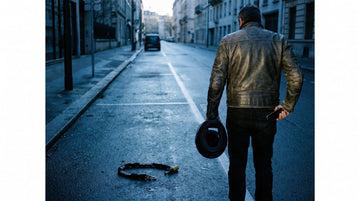

Motorcycle theft: what is the thieves' cooling-off stash?
 Par Thomas
The cooling-off stash is a well-oiled theft method: thieves lift a motorcycle without ever starting it, hide it a few kilometers away, then wait to see whether anyone comes for it. A motorcycle nobody comes looking for probably isn't being tracked, and can be sent off to be stripped for parts. On the night of August 11, in the Paris area, this exact scenario played out against a motorcycle fitted with a GeoRide. It was recovered that same morning.
The essentials
- At 4:53 am, a motorcycle leaves its parking spot in the Paris area without its engine ever running: a lift-away theft.
- 6 minutes and 9 km later, it's lying on its side in the undergrowth, hidden under cut branches.
- That's a cooling-off stash: the thief watches the motorcycle to make sure it isn't being tracked before stripping it for parts.
- Fitted with a GeoRide GPS tracker, it was located immediately and recovered that same morning.
What happened that night in the Paris area?
At 4:53 am, a motorcycle left its parking spot without the engine ever being started, and the GeoRide device fitted to it recorded every single meter of the route. 6 minutes later, after 9 km, it came to a stop at the edge of a wood.
That's where it was found: on its side in the undergrowth, covered with cut branches. Not dumped, not abandoned. Tucked away. Someone had taken the time to hide it properly, clearly planning to come back.
The motorcycle was recovered that same morning, before anyone came back for it. And that detail, the fact that it was hidden rather than hauled straight away, says something very specific about how thieves operate today.
What exactly is a cooling-off stash?
The cooling-off stash is a surveillance phase: after lifting the motorcycle, the thief hides it a few kilometers from the scene and waits to see whether anyone comes for it. It's the continuation of a lift-away theft, a method our 2026 GeoRide Theft Report measured on the ground with more than 4,600 riders.
The logic is simple. A thief can never be certain they've spotted and disabled every tracker on a motorcycle. So they run a test: if the motorcycle sits in its hiding spot for several days and nobody shows up, they conclude it isn't being tracked, and it can be stripped for parts without a worry.
What's striking is that this method only exists because GPS trackers work. Thieves have taken their effectiveness on board and reorganized the way they operate around it, often faster than the rest of the motorcycle world. To get the full picture, we've broken down the most common theft techniques in 2026.
Why was the motorcycle never started?
Because the vast majority of motorcycle thefts are lift-away thefts: according to the Mutuelle des Motards and GPS tracking providers, 90 to 95% of thefts follow this playbook. The thief isn't trying to start the motorcycle; they lift it and load it into a van.
The sequence is almost always the same. The motorcycle is lifted, the steering lock is broken, and it disappears into a truck. It's then moved to a stash while the thieves check it isn't connected. That window is precisely where everything is decided.
Against a lift-away theft, a lock on its own isn't enough: the motorcycle leaves with it. A lock secured to a fixed point makes the job harder and forces thieves to make noise, which still counts for something. But it doesn't warn anyone. That night, nobody heard a thing, and it was the device that did the talking.
What difference does a GPS tracker make against this method?
It turns the cooling-off stash against the people who use it: the thief's watching window becomes your recovery window. A real-time GPS tracker records the departure, the route and the stopping point, while the thief still believes they're testing the waters.
| Stage of the theft | Without a GPS tracker | With a real-time GPS tracker |
|---|---|---|
| Lift-away | The theft goes unnoticed until morning | Alert at the very first jolt, real-time position |
| Cooling-off stash | The motorcycle sits waiting to be stripped, invisible | The route and the stopping point are recorded |
| Recovery | 24.3% of stolen motorcycles and scooters are recovered (2025 Argos Barometer, France) | The exact position is passed on to law enforcement |
And often it never even gets that far. According to the 2026 GeoRide Theft Report, in 51.7% of attempts the alert was enough: the motorcycle wasn't moved, and the theft simply never happened. Deterrence first, recovery second. To understand the full mechanics of the device, our motorcycle GPS tracker guide breaks down how it all works.
"The whole point of GeoRide is to act when there's an emergency, and to have peace of mind the rest of the time," says Thomas, GeoRide's founder.

Why did the motorcycle have to be recovered that same morning?
Because time works against the motorcycle: past 48 hours, the chances of recovering a stolen motorcycle or scooter drop tenfold, according to data from Coyote and law enforcement. A motorcycle in a cooling-off stash is meant to stay there for several days, and every passing day brings the moment the thief comes back for it a little closer.
This time, there was also something at stake beyond the motorcycle itself. After weeks of drought, a motorcycle lying in dry undergrowth with fuel in its tank is a real fire risk. One more reason not to leave it sitting there.
One important word on what to do: never go to recover your motorcycle alone when a thief could be waiting. The right sequence is the alert, then the police, reached on 112 anywhere in Europe, with the real-time position to guide them. We've summed up the right reflexes for the first five minutes after a theft.
Where GeoRide comes in
This story is exactly what we're here for: a connected device on the motorcycle, an alert at the slightest jolt, the real-time position and, for riders in mainland France, 24/7 Theft Assistance working with law enforcement and calling you back in under 5 minutes. The whole thing installs in 5 minutes, two wires to the battery, and the device keeps running on its built-in battery even if the wires are ripped out.
Alerts reach you however you want them: a notification, an email, a phone call you can set for nighttime only, or an iOS critical alert that rings at full volume even in Do Not Disturb mode. At 4:53 am, that's what makes the difference between waking up in time and finding out at dawn.
The GeoRide 3s costs €299 with a €5/month subscription, no commitment (first month free). The GeoRide mini, at €199 with the same subscription, covers the essentials of protection. In both cases, the GPS tracker is only the visible part: it's the app and the assistance around it that turn a position into a recovered motorcycle.
"We have a bond with our motorcycles. Only riders can understand that," says Thomas, GeoRide's founder.
FAQ
What is the cooling-off stash after a motorcycle theft?
It's a surveillance phase: the thief hides the stolen motorcycle a few kilometers away and waits several days to check it isn't being tracked before stripping it for parts. If nobody comes for it, they take that as a green light. A GPS tracker turns that waiting period into an advantage: the position is known within the very first minutes.
Does a physical lock prevent a lift-away theft?
Not on its own: in a lift-away theft, the motorcycle leaves in the truck with its lock still on. A lock secured to a fixed point makes the job harder and forces thieves to make noise, but a U-lock gives way at about fifteen seconds per cut from a battery-powered angle grinder. The strategy that works pairs a physical deterrent with a real-time alert.
What should you do if your GPS tracker alerts you in the middle of the night?
Never confront a thief on your own: it achieves nothing and puts you in danger. Call the police, on 112 anywhere in Europe, and give them the real-time position through a simple web link. In mainland France, you can also trigger the 24/7 Theft Assistance in the GeoRide app, included in the subscription, and get a callback in under 5 minutes.
How many stolen motorcycles are recovered without a GPS tracker?
Roughly one in four: the recovery rate for stolen motorcycles and scooters in France is 24.3% according to the 2025 Argos Barometer. By contrast, the 2026 GeoRide Theft Report shows that in 51.7% of attempts on equipped motorcycles, the alert was enough and the motorcycle wasn't even moved.
Does a GPS tracker still work if the motorcycle is hidden deep in the countryside?
Yes: the GeoRide device relies on a multi-carrier network covering more than 200 countries and automatically picks the most reliable carrier for the area. And if an area has no coverage at all, local protection keeps recording events, along with the last known position and the route taken to get there.
This story was first told on GeoRide's LinkedIn page: read the original post.
À lire ensuite