
Motorcycle Safety Checklist: 8 Things to Check Before You Ride
Protect my motorcycle with GeoRide Par Thomas
Eight checks are all it takes to set off safe: certified gear, tires, brakes, chain and fluid levels, lights, theft protection, alarm and route planning. Give yourself a few minutes before you turn the key: that is what cuts your crash risk, keeps you from breaking down miles from home and lets you ride with a clear head. Here is the full checklist, point by point, with what to actually do.
Key takeaways
- An approved helmet and CE-certified gloves are compulsory in France; a reinforced jacket, over-the-ankle boots and an airbag are what really count in a fall.
- Tires and brakes deserve a weekly look: cold pressure, wear, pads and brake fluid.
- Safety includes theft: according to the 2026 GeoRide Motorcycle Theft Report for France, more than one theft in two is stopped by nothing more than the real-time alert from a GPS tracker.
- Before a long ride: weather, route and location sharing with your loved ones.
What gear should you ride in?
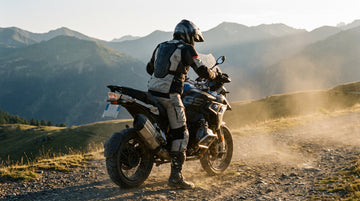
An approved helmet (ECE 22-05 or 22-06 standard) and CE-certified gloves: in France that is the legal minimum for every rider, passenger included. Ride there without a helmet and it costs you a €135 fine and 3 points off your license; without gloves, €68 and 1 point. The high-visibility vest does not have to be worn, but it has to stay within reach, ready to pull on if you have to stop in an emergency on the road.
| Gear | Legal status | Reference standard |
|---|---|---|
| Helmet | Compulsory | ECE 22-05 or 22-06 |
| Gloves | Compulsory in France since 2016 | CE certified (EN 13594) |
| High-visibility vest | Carry it with you, wear it if you stop in an emergency | EN ISO 20471 |
| Jacket and pants | Recommended | EN 1621 (protectors), EN 17092 |
| Over-the-ankle boots | Recommended | EN 13634 |
| Airbag | Recommended | EN 1621-4 |
None of the rest is compulsory, but a jacket with certified armor, reinforced pants and over-the-ankle boots completely change how a slide ends. Pick your level of protection to match the way you ride: full-on for the open road and long trips, lighter for the city.
Then there is the airbag, the one everybody leaves off the list.
"An airbag is a must on a motorcycle. Seriously, it saves lives." (Thomas, GeoRide founder)
One last habit: go over your gear regularly. A helmet that has taken a hit, worn-out gloves or a tired zip protect you less, and they need replacing before they let you down at the worst possible moment.
Tires and brakes: what should you check before you set off?
Check your tire pressure once a week, cold, and look the brakes over while you are at it: those are the two checks that weigh most on your safety.
For tires, the reference figure is on the swingarm sticker or in your owner's manual; Motonaut, the assistant built into the GeoRide app for free, gives it to you too, for the exact year of your model. Run a tire under-inflated and it loses grip and stability; over-inflated, it holds on less well in the wet. While you are down there, look the rubber over: even wear, no cracks or debris stuck in the tread, wear indicators still a long way off. A tire more than five years old (the DOT code stamped on the sidewall gives its manufacturing date) is worth a professional opinion, even if it looks healthy. If you want to go deeper, we have put together a full guide on monitoring tire pressure.
For brakes, three checks. Pads first: if metal is showing or the wear indicator starts squealing, replace them. Discs next: a smooth surface, no deep scoring, no warping. Brake fluid last: level above the mark and light in color, because dark fluid has taken on moisture and brakes less well. Give the lines a look too: no cracking, no swelling, nothing rubbing. Since periodic vehicle inspections came in for motorcycles in France in April 2024, these points get checked at regular intervals anyway.
If you would rather keep an eye on it continuously, Live Wheel sensors measure your tires' pressure and temperature in real time and alert your phone as soon as a value drifts out of range, slow leaks included.
Chain, fluid levels, lights: which checks keep you from breaking down?
Three quick jobs: keep an eye on the chain, check the fluid levels and test every light. That trio is what saves you from a breakdown in the middle of nowhere.
The chain first: check the slack in the middle of the lower run (the exact figure is in your owner's manual) and lube it with a motorcycle-specific product, turning the rear wheel so it spreads evenly. A dry, slack or corroded chain wears fast and can snap while you ride. Check the links and O-rings at the same time.
Fluid levels next: engine oil between the two marks, bike upright and cold, and clear coolant in the expansion tank. Oil gone black and full of particles, or brownish coolant, means a change now rather than later.
Lights last: low beam, brake light, turn signals, the full round in thirty seconds. Being seen counts as much as braking well, especially at night or in the rain.
To keep up the rhythm without thinking about it, the GeoRide app has customizable maintenance reminders: chain lube, oil change by mileage, tire pressure, annual service. And if you want to put some structure on all of it, here are the maintenance tasks to plan every month.
Why is theft protection part of a safety checklist?
Because a motorcycle gets stolen without ever being started: in 90 to 95% of cases, according to the Mutuelle des Motards (a French motorcycle insurer) and tracking providers, the thief lifts the bike, breaks the steering lock and loads it into a van. And close to one theft in two happens somewhere people think of as safe: a shared garage, the basement of an apartment building.
A physical lock is still worth having: anchored to a fixed point, it stops an easy lift-away and forces the thief to make noise. Just do not ask more of it than it can give: a modern battery-powered angle grinder gets through an approved U-lock in about fifteen seconds a cut. The real answer is knowing straight away that something is happening.
That is exactly what a real-time GPS tracker gives you: at the slightest vibration or suspicious movement, your phone rings, wherever you are. And that one alert changes how the story ends:
51.7%
of theft attempts stopped in their tracks: the alert was enough, the bike never moved (2026 GeoRide Motorcycle Theft Report for France, 385 victims analyzed).
In other words, more than half the time the theft does not even happen: the thief runs before finishing the job. And when a bike really does get moved, the tracker's real-time location lets GeoRide Theft Assistance, available in France, coordinate with the police, without you ever putting yourself in danger. To round out your setup, have a look at the mistakes that still make theft easy and the right moves in the first minutes after a theft.

How do you plan your ride and put your loved ones at ease?
Three habits before a long ride: check the weather along the route, plan your stops and share your location with someone close to you. Prep does not hold up your departure, it takes the nasty surprises out of it.
Location sharing, for one, no longer asks your loved ones to install anything: the GeoRide app generates a web link that shows your progress live in any browser. You can also go for the "only if I have a fall" mode: they see nothing as long as all is well, zero tracking, and they get a heads-up if something happens. We break down this new-generation sharing here.
And if you do go down anyway, the device picks it up on its own: with no reply from you, the emergency services are alerted automatically in under 2 minutes, and to the right place (motorway control center on a motorway, fire service or ambulance elsewhere), even if your phone is smashed or dead. Emergency dispatch covers mainland France; everywhere else, your loved ones are alerted automatically.
A bonus, just for the fun of it: every ride is recorded automatically, with the route, the weather and the towns you rode through. You leave with a clear head, and you come home with a ride to relive.
Where GeoRide fits in
Out of the eight points on the checklist, GeoRide covers four on its own: theft protection, tire monitoring, maintenance reminders and safety while you ride.
"An app that connects to your bike to protect it from theft, replay all your rides and put your loved ones at ease." (Thomas, GeoRide founder)

In practice, the GPS tracker takes 5 minutes to install (two wires to the battery) and everything runs from the app. The GeoRide 3s adds Radar detection even underground and Automatic phone recognition; the GeoRide mini sticks to the essentials, to buy from €199, then €5 a month with No commitment. And for the tire part of the checklist, Live Wheel sensors screw on in place of your valve caps in 2 minutes and watch pressure and temperature nonstop.
FAQ
What gear is compulsory on a motorcycle in France?
An approved helmet (ECE 22-05 or 22-06) and CE-certified gloves are compulsory, for rider and passenger alike. The high-visibility vest has to be with you and goes on if you stop in an emergency. Jacket, reinforced pants, boots and airbag stay optional, but they are strongly recommended.
How often should you check motorcycle tire pressure?
Once a week, cold, is the right rhythm. The reference figure is on the swingarm sticker or in the manual, and smart sensors like Live Wheel can watch the pressure continuously and warn you if it is leaking slowly.
Is a physical lock enough to protect my motorcycle?
No, a physical lock on its own no longer cuts it: the vast majority of thefts are lift-away thefts, with the bike never started, and a U-lock gives way to an angle grinder in about fifteen seconds. It is still useful for slowing the thief down and forcing them to make noise, but it is the real-time alert from a GPS tracker that scares the thief off more than half the time, according to the 2026 GeoRide Theft Report.
What happens if you have a fall with a GeoRide?
The emergency services are alerted automatically in under 2 minutes if you do not respond, even with a smashed or dead phone. Emergency dispatch covers mainland France, and your loved ones can be alerted depending on your sharing settings.
À lire ensuite