
How to protect your motorcycle from theft, layer by layer
Protect my motorcycle with GeoRide Par Thomas
To protect your motorcycle from theft, stack three layers of defense: a physical lock anchored to a fixed point to slow thieves down, a parking spot chosen to put them off, and a GPS tracker with real-time alerts so you know the second someone lays a hand on your bike. No single protection is enough on its own: it is the combination that makes thieves give up.
The key points
- 90 to 95% of motorcycle and scooter thefts are lift-away jobs: the bike is picked up and loaded into a van, never started.
- A U-lock gives way in about fifteen seconds to a battery-powered angle grinder: it slows things down, it does not warn you.
- The right strategy stacks three layers: physical (slow them down), parking (deter), connected alert (react).
- In the 2026 GeoRide Motorcycle Theft Report for France, 51.7% of attempts ended at the alert: the bike never moved.
Why do thieves target your bike?
Because it sells on fast, moves easily and can be gone in minutes. In 2025, GIE Argos, the French insurers' stolen vehicle body, counted 15,975 motorcycle and scooter thefts declared and paid out, but the real number is put at 55,000 to 60,000 a year by Argos and the Mutuelle des Motards, France's rider-owned insurer. That works out at one bike stolen every 10 minutes in France.
Thieves do not pick at random. The 2026 GeoRide Motorcycle Theft Report for France, a survey of more than 4,600 riders, found that 73% of the bikes targeted are Yamahas, BMWs or Hondas, and 53% are worth between €6,000 and €15,000. Recent, popular models go first: they feed a well organized market for resale and spare parts.
Another idea worth dropping: theft is not just a street thing. Around half of all thefts happen in places that feel safe: shared garages, residential basements, private garages. And without a tracker, the national recovery rate tops out at 24.3% according to the 2025 Argos Barometer: three stolen bikes out of four never make it back to their owner.
How do thieves actually work?
In the vast majority of cases they never start the bike: they carry it off. According to the Mutuelle des Motards and geolocation operators, 90 to 95% of thefts are lift-away jobs. The script barely changes: several people lift the bike, break the steering lock, load it into a truck, then stash it somewhere quiet long enough to check whether it is connected.
That stash phase is exactly where a GPS tracker and the police take back control: a bike you can locate can be recovered, sometimes with the thieves caught in the act. On raw speed, though, the numbers are brutal: the average theft takes two and a half minutes, and under a minute when the bike is not secured to a fixed point.
Two profiles are worth separating. The opportunist takes what is going: a bike on its own, no lock, a dark street. Organized crews work differently: they pick out a specific model, learn parking habits and turn up with the right tools. Against them, one protection alone counts for little: every extra obstacle stretches their working time and raises the odds of being seen. For a closer look at their methods, read our breakdown of the most common theft techniques.
Is a physical lock still enough?
Not any more: against a modern battery-powered angle grinder, a top-end U-lock gives way in about fifteen seconds per cut. The famous "two minutes of resistance" comes from approval testing, done with a hand saw, a tool no thief bothers with today.
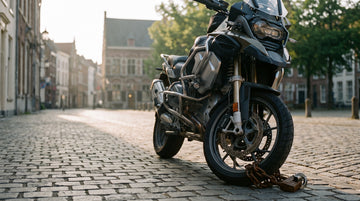
Does that make the physical lock pointless? Far from it. Anchored to a fixed point, it stops the bike being carried off by hand, forces thieves to bring out a noisy tool and puts them in full view. It is still the first layer you need. Just see it for what it is: a delaying tactic, not a bodyguard. It will never tell you someone is busy cutting through it.
That is exactly what happened to Thomas, GeoRide's founder, back in 2017: his bike anchored to a fixed point with a lock and an alarmed disc lock, everything cut through, on the morning he was leaving on a road trip. The audible alarm did nothing at all, he lived two floors up.
"It drove me crazy that we were using sound to warn people about a problem, when we all have a phone in our pocket."
Thomas, GeoRide founder

Which protections should you combine to really stop worrying?
The winning combination pairs one protection that slows things down, one that alerts you and one that locates. Each device has a precise limit, and the next one fills it:
| Protection | What it does | Its limit |
|---|---|---|
| U-lock or chain on a fixed point | Stops the bike being carried off by hand, forces the use of tools | Gives way to an angle grinder in seconds, does not warn you |
| Alarmed disc lock | Locks the wheel, sets off an audible signal | The sound never reaches you, the bike can still be lifted |
| Bluetooth tag (AirTag type) | Gives a rough position | Relies on phones nearby, not built for motorcycle security |
| Connected GPS tracker | Real-time alerts, precise location, assistance | Does not physically stop the bike being moved |
The link that changes everything is the real-time alert. A connected GPS tracker like GeoRide picks up the first jolt and warns you straight away by push notification, phone call or email: thieves lose their biggest asset, discretion. To understand how the technology works and pick the right model, our complete guide to motorcycle GPS trackers goes through every criterion.
And none of this is theory. Deterrence can be measured:
51.7%
of the theft attempts logged by the 2026 GeoRide Theft Report ended at the alert: the bike was never moved (199 bikes out of 385 theft alerts).
One bike in two, in other words: a theft avoided. Thieves who work out that the owner already knows simply walk away. Add visible protection (a chunky chain, a brightly colored disc lock) and you stack visible deterrence on top of invisible monitoring.
Where and how should you park to cut the risk?
The best spot is lit, busy, and lets you anchor the bike to a fixed point. Thieves want quick, discreet targets: a space under a street light, next to a shop or a building entrance already makes their job harder. Outside, always secure the bike to something solid: remember, with nothing to anchor it, lifting it away takes under a minute.
Watch out for false security, though: around 50% of thefts happen in places that feel safe, shared garages and basements first among them. A shared garage whose access fob does the rounds, a residential parking you get into by following a car in: for an organized crew, that is a quiet hunting ground with no witnesses. Physical and connected protection matter there just as much as out on the street.
A few habits round it off: always engage the steering lock, move your parking spot around so you do not build routines anyone can spot, and avoid leaving the bike in the same place for weeks on end. We have put the most common traps together in our article on the 10 mistakes too many riders still make.
What if the theft happens anyway?
One absolute rule: never take on a thief alone. A motorcycle can be replaced, you cannot. What makes the difference is not confrontation, it is how fast you react: according to police figures relayed by Coyote, past 48 hours the chances of recovery drop tenfold.
If your bike has a tracker, call in your provider's assistance as soon as you notice it is gone. With GeoRide, 24/7 Theft Assistance is available in mainland France and included in the subscription: you get a call back in under 5 minutes and the team coordinates directly with law enforcement, who receive the position in real time through a simple web link. That fast coordination is what makes it possible to step in during the stash phase, while the bike can still be recovered.
Always file a police report, even for an attempt: 40.3% of theft incidents are never reported to the insurer according to the 2026 GeoRide Theft Report, which skews the statistics and costs riders their rights. For the exact running order of the first moves, keep our guide to the first 5 minutes after a motorcycle theft handy.
What GeoRide brings to the table
GeoRide covers the layer nothing else does: knowing, in real time, that your bike is in danger. The device installs in 5 minutes, picks up the slightest vibration and alerts you on four channels you can configure: push notification, phone call, email, and the iOS critical alert that rings even in Do Not Disturb mode. If the cables are ripped out, the built-in battery takes over for hundreds of kilometers.
Where a traditional GPS tracking device sends one position every 5 minutes, GeoRide sends up to 10 positions per second through corners. The GeoRide mini covers the essentials, the GeoRide 3s adds Automatic phone recognition and the radar detection that lets you find your bike even underground, in exactly those places that feel safe where around half of thefts happen. And to round off the deterrence, the 110 dB Live Alarm goes off remotely from the app, from anywhere in the world.
More than 30,000 riders now protect their motorcycle with GeoRide, by buying the device outright or, in France, Belgium, Italy and Switzerland, by renting it with no commitment from €9.99 a month. Without ever tipping into paranoia: 95% of the time nothing happens, and that is exactly the point.
"The point of GeoRide is to act in an emergency, and to feel relaxed the rest of the time."
Thomas, GeoRide founder
FAQ
What is the most effective lock against motorcycle theft?
The most effective answer is not one lock but a combination: a U-lock or chain anchored to a fixed point, a lit and busy parking spot, and a GPS tracker that alerts you in real time. The physical lock slows things down and deters, the tracker warns and locates: each one fills the other's gap. A bike with all three layers takes too much time and too much risk to stay an interesting target.
Does a GPS tracker really prevent motorcycle theft?
It does not physically immobilize the bike, but it stops most attempts: in the 2026 GeoRide Motorcycle Theft Report for France, 51.7% of attempts ended at the alert and the bike was never moved. Thieves who know the owner has already been warned usually give up. And if the bike really does move, the real-time location passed to the police makes it possible to act during the stash phase.
Where should you park a motorcycle to avoid theft?
Somewhere lit and busy, with the bike anchored to a fixed point. Beware the false security of garages and basements: around half of thefts happen there. Wherever you park, keep the same habits: steering lock engaged, physical protection anchored, connected alert active, and vary your spots so nobody can case you.
Can a GPS tracker lower my motorcycle insurance?
Yes, a GPS tracker can bring down the premium or the excess with some insurers. Conditions vary from one company to the next: the simplest move is to tell your insurer what you have fitted and ask what they offer. Either way, an extra protection device can only strengthen your case.
What should I do if I catch someone stealing my motorcycle?
Never step in alone: call the police straight away and let the kit do its job. A confrontation puts you in danger for almost nothing. If the bike has a GeoRide fitted, trigger Theft assistance in the app, available in mainland France: you get a call back in under 5 minutes and the real-time position goes to law enforcement.
À lire ensuite