
Motorcycle tire pressure: how to monitor it the right way
Protect my motorcycle with GeoRide Par Thomas
There are two ways to stay on top of your motorcycle tire pressure, and they work together: a manual check with a gauge, cold, every two weeks, and real-time monitoring with TPMS sensors like GeoRide's Live Wheel. The reference pressure is always the manufacturer's, printed in your owner's manual or on the swingarm. Properly inflated, your tires grip better, shorten your braking distances and last longer.
The essentials
- Check the pressure cold (bike parked up for 2 hours), with a reliable gauge, every two weeks.
- The right pressure is the manufacturer's, never the figure molded into the tire sidewall (that is a maximum, not a recommendation).
- Adjust your inflation: around 0.2 bar more at the rear two-up or loaded, 0.2 bar more in cold weather.
- A TPMS like the Live Wheel tracks pressure and temperature non-stop and alerts you instantly when something is off.
What is the right pressure for your motorcycle tires?
The right pressure is the one your motorcycle's manufacturer recommends: look in the owner's manual, or on the sticker stuck to the swingarm, the chain guard or the frame. Those figures account for the weight, the geometry and the original tires of your machine. No single pressure works for every motorcycle.
Watch out for one classic trap: the figure molded into the tire sidewall is not a recommendation. It is the maximum pressure the tire can take at full load. Set your pressures to that and you ride permanently over-inflated.
Pressures come in bar or in PSI. To switch from one to the other: 1 bar = 14.5 PSI. Our motorcycle tire pressure converter does the conversion for you in one click.
Last rule, and the most important one: always check cold, meaning the bike has not turned a wheel for at least two hours. Heat pushes the pressure up by roughly 0.2 bar, which throws your reading off. And never bleed air out of a hot tire: once it cools down it will be under-inflated, exactly what you were trying to avoid.
Should you adjust the pressure for load and terrain?
Yes: the manufacturer's reference pressure gets tweaked for load, weather and terrain. Two-up or with heavy luggage, add around 0.2 bar to the rear tire. When it turns cold, add 0.2 bar to your usual settings too: air contracts as the temperature drops.
Here are some typical ballpark figures, measured cold, by type of motorcycle and by use. Your own manual is still the only reference that counts for your exact model.
| Type of motorcycle / use | Front (cold) | Rear (cold) |
|---|---|---|
| Sports bike / roadster (road) | 2.5 bar | 2.9 bar |
| Tourer / touring | 2.6 bar | 2.9 bar |
| Two-up / luggage | 2.6 bar | 3.0 bar |
| Track (road tires) | 2.1 bar | 1.9 bar |
| Motocross | 0.9 bar | 0.9 bar |
| Enduro | 1.0 bar | 1.0 bar |
Off-road, pressures drop a long way, down to somewhere between 0.8 and 1.2 bar, to gain grip on loose ground. If you have to head back onto the road with those settings, raise the pressure a little and keep both your speed and the length of the trip down: an under-inflated off-road tire wears out fast on asphalt.
How do you check the pressure properly with a gauge?
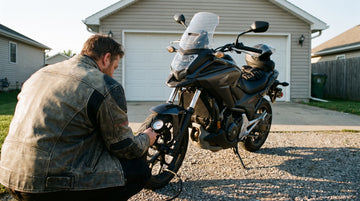
The manual method is still a solid bet, as long as you have the right tool and the right technique. Start by buying your own gauge: the machines at service stations are often out of calibration, because nobody looks after them. A digital gauge gives you precise readings that are easy to read, and it does not cost a fortune.
The check itself takes a minute per wheel:
- Look up the recommended pressures (sticker or manual).
- Take off the valve cap and hold the gauge square to the valve, so no air escapes while you read.
- Compare what you read with the recommendation: too low, add air with a pump or a portable compressor; too high, press gently on the valve to let some out.
- Put the valve cap back on. It keeps dirt and moisture away from the valve, and those are what cause slow leaks.
Use every check as an excuse to look over the tread and the sidewalls: uneven wear, cracking, anything embedded in the rubber. A nail stuck in a tire can sit there for weeks leaking slowly, and that is exactly the kind of trap a regular visual check catches in time.
How often should you check your tire pressure?
Every two weeks ideally, and every week if you ride a lot. A tire in perfect condition loses pressure on its own over time: it is a normal physical process called permeation, air slowly migrating through the rubber.
0.1 bar
That is roughly what a tire loses every month through permeation alone, with no flat and no faulty valve. Go a few months without a check and you are riding noticeably below the recommended pressure.
This is where most riders get caught out: not by the dramatic flat, but by the slow, invisible drop. The bike takes a little more effort to tip into a corner, the tire runs hotter, wears faster on the sidewalls, and fuel consumption creeps up. Nothing alarming day to day, but it all adds up, in handling and in how long your tires last.
The easiest fix is to lock this check into a regular maintenance routine, alongside chain lubrication and fluid levels. Our guide to monthly maintenance tasks helps you get organized without losing your Sundays to it.
Why a TPMS changes the game
A TPMS (Tire Pressure Monitoring System) watches the pressure continuously, including while you ride, where a gauge only ever gives you a snapshot at a standstill. Sensors measure the pressure and the temperature of each tire and send the data to a phone app. At the first sign of trouble, a flat, a slow leak or an abnormal pressure, you get an alert straight away.
In practice, the difference shows up on the road. A flat gives no warning: it can happen ten minutes after a flawless manual check. With a TPMS you are alerted while the tire is going down, with time to slow up and pull over safely instead of finding out the hard way at your first heavy stop.
There are three families of sensors. External sensors screw onto the valve in place of the cap: two minutes to fit, no wheel to remove. Internal sensors, mounted inside the tire, are better protected but need a professional for the fitting and for battery changes. And some high-end motorcycles come with a factory TPMS built in by the manufacturer.
One more benefit that often gets overlooked: temperature. No ordinary gauge tells you that, and it is what lets you spot abnormal overheating, useful information on long summer rides or on the highway.

How good is the Live Wheel at monitoring your tires in real time?
The Live Wheel is GeoRide's smart TPMS: two compact sensors, one for the front and one for the rear, that replace your valve caps and report your tire pressure and temperature in real time in the GeoRide app. The full kit, both sensors included, costs €89.
“Live Wheel monitors the pressure and the temperature of your tires in real time, and alerts you instantly in the event of a leak or low pressure.” (Thomas, GeoRide founder)

Fitting comes down to a few moves: take off the valve caps, slide on the anti-theft nut supplied, screw on the numbered sensor (1 at the front, 2 at the rear), tighten it with the wrench included, then scan the QR code in the app to pair the sensors with your device. A short ride is all it takes to wake them up. Budget two minutes, with nothing to take apart.
Out on the road, everything updates live in the app: you see the pressure and the temperature of each tire as the ride goes on. If you pick up a flat or drop below the recommended threshold, the alert fires immediately, and those few seconds are exactly what you need to get yourself somewhere safe. The anti-theft nuts keep the sensors out of reach of sticky fingers, and the logo even comes off if you would rather stay discreet.
One compatibility point to know before you buy: the Live Wheel works only with the GeoRide 3s. It is compatible with neither the GeoRide mini nor the GeoRide 3. If you are torn between the two devices, our GeoRide mini or GeoRide 3s comparison spells out what each one can do.
Where GeoRide comes in
Tire pressure is the textbook maintenance job: everyone knows it by heart and everyone forgets it anyway. GeoRide covers it from both ends: automatic monitoring with the Live Wheel, and smart reminders in the app. The customizable maintenance reminders cover tire pressure, chain lubrication, oil changes and the annual service, and our real-time maintenance alerts explain how it all works.
Not sure what pressure your model calls for? Motonaut, the 100% motorcycle AI assistant built into the GeoRide app and free for everyone, adjusts to the exact year of your machine and gives you the right pressure for your tires in seconds, straight from the manufacturer's manual.
And the device running all of this, the GeoRide 3s, does more than keep an eye on your tires: real-time GPS tracker, smart alarm, fall detection that alerts your loved ones automatically (with an automatic emergency call in France), automatic ride recording. A standard GPS tracker locates your motorcycle; the GeoRide 3s looks after it, and after you.
FAQ
Should you check tire pressure hot or cold?
Always cold: the bike must not have been ridden for at least two hours. Heat raises the pressure by around 0.2 bar and throws the reading off. Never bleed air out of a hot tire, it would end up under-inflated once it cools down.
Does a tire lose pressure even without a flat?
Yes, a tire in perfect condition loses pressure naturally, in the region of 0.1 bar a month, purely from air permeating through the rubber. That is why a check every two weeks is recommended, or continuous monitoring with a TPMS.
What are the signs of a badly inflated tire while you ride?
The clearest sign is a change in how the bike behaves: heavier steering and a bike that drops into corners less naturally with an under-inflated tire, a floaty feel and less grip with an over-inflated one. At the slightest doubt, pull over and check, or go by the alert from your TPMS.
Is the Live Wheel compatible with the GeoRide mini?
No, the Live Wheel works only with the GeoRide 3s. It is compatible with neither the GeoRide mini nor the GeoRide 3. The kit of two sensors (front and rear) costs €89 and goes onto the valves in two minutes.
What should you do if the pressure keeps dropping even after you reinflate?
A fast, repeated loss usually comes from a damaged valve, a poor seal between the tire and the rim, or something stuck in the rubber (a nail, a screw) leaking slowly. Get the wheel checked by a tire specialist without waiting: a slow leak can turn into a full flat in the middle of a ride.
À lire ensuite