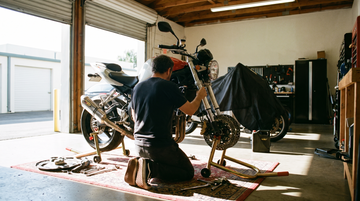

Motorcycle maintenance: the checks to run every month at home
Protect my motorcycle with GeoRide Par Thomas
Monthly motorcycle maintenance comes down to seven simple checks: fluid levels (oil, brake fluid, coolant), tire pressure and wear, brakes, chain, battery, lights and fasteners. You don't need a pro's toolbox: all of it happens at home, in a single session, and it heads off the vast majority of breakdowns and expensive repairs.
In short
- Seven things to go through every month: fluid levels, tires, brakes, chain, battery, lights, fasteners.
- Basic gear does the job: your eyes, a pressure gauge, a brush and some chain lube.
- The exact intervals (oil change, brake fluid, chain and sprocket kit) live in the owner's manual, and Motonaut digs them out in seconds.
- The GeoRide app sends customizable maintenance reminders so nothing slips by.
Why does a monthly check change everything?
Because almost no breakdown drops out of nowhere: a chain that slaps, a brake that goes soft, a battery that gives up, they all announce themselves weeks ahead to anyone who takes the time to look. That is exactly what the monthly ritual is for: catching the weak signals while they are still easy, and cheap, to put right.
Safety comes first. Your tires are the only contact between the motorcycle and the road, your brakes your only way out when things go wrong: a fault in either one does not forgive. A well-drilled safety checklist before you set off works alongside this deeper monthly check.
Then there is money. A chain greased regularly lasts far longer than a chain left to fend for itself, pads swapped in time save the discs, a level you keep an eye on reveals a leak before it wrecks the engine. Preventive maintenance always costs less than the repair it saves you.
And then there is the sheer pleasure of it. Spending half a day a month with your hands on your machine is how you get to know it, feel what is changing, and ride with a clearer head.
"We get attached to our motorcycles. Only riders can really understand that." Thomas, GeoRide founder
Which fluid levels should you check every month?
Three levels are worth a monthly look: engine oil, brake fluid and coolant. For a reading you can trust, hold the bike upright, on level ground, engine cold.
Engine oil shows up in the sight glass or on the dipstick, between the "min" and "max" marks. It lubricates the internals and helps cool the engine: a level that drops abnormally from one month to the next should ring a bell, since it often points to a leak or heavy consumption.
Brake fluid is judged on level and color. Dark or cloudy fluid has lost its properties: have it replaced. A falling level can also give away pads at the end of the road, since the pistons creep out of the calipers as the friction material wears down.
Coolant is checked in the expansion tank, never by opening the system while it is hot. It turns critical on long summer rides, where the slightest shortfall gets paid back in overheating.
When it comes to replacements (oil change, brake fluid bleed), go by your manufacturer's recommendations rather than any universal rule: every engine has its own. Our motorcycle maintenance calculator helps you plan those deadlines instead of being caught out by them.
Tires and brakes: what can you check without being a mechanic?
Two things on the tires: pressure and the state of the rubber. Pressure is measured cold, with a gauge, against the values your manufacturer gives. It shifts with the outside temperature, which is why a proper monthly check earns its place alongside the quick glance before every ride. To see what a few tenths of a bar do to the way your bike handles, our guide to monitoring tire pressure goes into detail.
On the rubber, hunt for the wear indicators at the bottom of the grooves, cracks in the sidewalls, uneven wear and anything stuck in the tread: a nail can sit there quietly for weeks before it turns into a flat. If you ride a GeoRide 3s, Live Wheel sensors screw on in place of your valve caps and watch pressure and temperature in real time, with an instant alert if you spring a leak or drop below the recommended pressure.
For the brakes, the test is simple: at a standstill, work the lever and the pedal. The resistance should feel firm, the return crisp. A spongy feel points to air in the system. Then check the pad thickness through the caliper: if the friction material is getting close to the wear indicator, replace them right away. Finally, look over the discs: deep grooves or visible warping are the mark of advanced wear.
Chain, cables, controls: what needs doing regularly?
The chain asks for three things: cleaning, greasing, tensioning. Degrease it with a suitable product and a brush, let it dry, then work the lube onto the inside of the chain while you turn the rear wheel so it spreads evenly. A chain that gets looked after lasts several times longer than a chain left alone: it is one of the best returns on effort in all of motorcycle maintenance.
Tension is set to the figures in the owner's manual, neither too tight (the output shaft bearings pay for it) nor too loose (snatching, risk of the chain jumping off). While you are down there, look at the rear sprocket and the front sprocket: pointed or hooked teeth mean the whole kit is due for replacement.
Cables and controls take seconds to test: throttle and clutch should move smoothly and snap back into place. A jerky action, friction inside the outer cable or frayed strands at the cable stops are clear warnings: a worn cable always snaps at the worst possible moment, and losing your clutch in traffic is nothing to shrug at.
How often should each check be done?
Not everything runs on the same clock: some jobs go before every ride, others once a month, and the rest follow the service book. Here is how it splits up:
| Item | Before you ride | Every month | Per the owner's manual |
|---|---|---|---|
| Tires | Quick visual check | Pressure with a gauge, state of the rubber | Replacement |
| Brakes | Lever and pedal test | Pads, discs, fluid level | Fluid bleed |
| Chain | Visual tension check | Cleaning, greasing, adjustment | Kit replacement |
| Fluid levels | - | Oil, coolant, brake fluid | Oil change, replacement |
| Battery and lights | Lights and indicators | Terminals, charge, brake light | Replacement |
| Fasteners and frame | - | Visible bolts, visual inspection | Torque check at a workshop |
For the exact figures on your model, the owner's manual stays the reference. And that is precisely the kind of digging Motonaut, the 100% motorcycle AI assistant built into the GeoRide app, does for you: it works from the exact year of your machine and answers on maintenance, tire pressure or the steps of an oil change.
136 pages
That is the manual for a 2025 Yamaha MT-07. Motonaut loads it in a split second to hand you the exact tire pressures or walk you through an oil change step by step.
Battery and lights: how do you avoid a dumb breakdown?
Electrical trouble is the most common of the avoidable breakdowns, and the easiest to head off: a monthly battery check and a full lights test are all it takes. Switch everything on, headlight, low and high beam, tail light, indicators, and trigger the brake light from the lever and then from the pedal: both controls should fire it.
On the battery side, make sure the terminals are clean and tight, with no sign of corrosion. A tired battery gives itself away with a lazy start, especially first thing in the morning or after the bike has sat. Winter and long layoffs are its worst enemies: our article on common motorcycle battery problems runs through the fixes.
This is one area where a connected GPS tracker changes the game. The GeoRide app dashboard shows your bike's battery voltage at all times, along with the odometer and the temperature where the bike is parked: you watch the charge fade before it leaves you stranded, without lifting the seat. And the device itself draws very little power, so the motorcycle fires up every time, even after a long spell standing still.

Where GeoRide comes in
GeoRide is not just an anti-theft GPS tracker: it doubles as a living service book. The app offers customizable maintenance reminders, tire pressure, chain greasing, oil change by mileage, tire replacement, annual service: you set the rule once, and the app pings you at the right moment. How it works is spelled out in our article on real-time maintenance alerts.
The bike dashboard rounds it out: real mileage logged by the tracker, battery voltage, temperature where you park. On the GeoRide 3s, Live Wheel sensors add real-time tire pressure and temperature. And for anything mechanical, Motonaut is free and open to every rider, even without a GeoRide GPS tracker: enough to turn a monthly ritual you sometimes forget into a routine with backup, while the GeoRide device keeps watch over the bike between rides.
Frequently asked questions
What tools do you need for basic monthly maintenance?
A pressure gauge, a brush and a degreaser for the chain, some chain lube and a standard set of wrenches will cover it. With that kit you handle tire pressure, cleaning and greasing the chain, checking fluid levels and retightening visible bolts. Everything else (bleeding the brakes, precise torque settings) belongs in a workshop.
Which warning signs should send you straight to a workshop?
A soft or spongy brake lever, a metallic noise under braking, uneven tire wear, play in the steering or an oil leak on the fork legs all call for a professional. These symptoms point to problems that get worse fast and go straight to your safety: better a quick diagnosis than a bike off the road, or worse, a crash.
How do you find the exact service intervals for your motorcycle?
They sit in the owner's manual, specific to each model and each year. Rather than hunting through a PDF, you can ask Motonaut, the free AI assistant in the GeoRide app: it works from the exact year of your motorcycle and answers on maintenance, tire pressure or the steps of an oil change, in seconds.
Can the GeoRide app remind you what needs servicing?
Yes, the maintenance reminders in the GeoRide app are customizable: tire pressure, chain greasing, oil change by mileage, tire replacement and annual service. Since the GPS tracker logs the bike's real mileage, distance-based reminders land at the right moment, not on a rough guess.
À lire ensuite