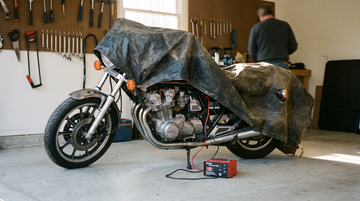

How to choose a smart charger for your motorcycle battery
Protect my motorcycle with GeoRide Par Thomas
Picking a smart charger for your motorcycle comes down to three checks: it has to match your battery chemistry (lead-acid, AGM, gel or lithium), run at the right voltage (6 V or 12 V) and deliver 0.8 to 2 A for everyday maintenance. Add a maintenance mode for winter storage plus protection against reverse polarity, and you can forget about a dead battery on the first sunny day of the year.
In short
- Compatibility comes first: work out your battery chemistry (lead-acid, AGM, gel, lithium) and its voltage before you buy anything. A lithium battery needs a dedicated charger, or at least a dedicated mode.
- 0.8 to 2 A covers regular maintenance; 6 to 8 A only earns its keep when you need to fill a big-capacity battery fast.
- Maintenance mode means you can leave the charger plugged in all winter with no risk of overcharging.
- Budget around €20 for a basic model, and over €150 for a high-end lithium-compatible charger.
What makes a charger smart, and why not just use a conventional one?
A smart charger reads the state of your battery in real time and sets voltage and current by itself, where a conventional charger just pushes out a fixed current and never knows when to stop. In practice, its processor works out which battery it is dealing with, runs the matching charging program, then drops down to a trickle charge once the battery is full. You can leave it plugged in for weeks and never give it a thought.
That multi-stage charging is what makes a battery last. Heavy current only goes in while the battery can take it, then it tapers off gradually, which stops the battery cooking itself and drying out its electrolyte. Decent models also come with protection against reverse polarity, short circuits and overheating, so a wiring slip no longer costs you a battery.
Some go further still, with a pulse desulfation function that can wake up a battery flattened by months of standing still, or temperature compensation that adjusts the charge to how cold your garage actually gets.
| Feature | Conventional charger | Smart charger |
|---|---|---|
| Voltage adjustment | Manual or fixed | Automatic |
| Overcharge protection | Rare, often none | Built in (automatic cut-off) |
| Battery recovery | No | Yes (desulfation) |
| Maintenance mode | No | Yes (float charging) |
| Safety features | Minimal | Reverse polarity, short circuit, overheating |
What kind of battery is in your motorcycle?
The battery you have dictates the charger you need, so start there. Read the label on the casing: you are looking for wording like "Lead-Acid", "AGM", "VRLA", "Gel" or "Lithium/LiFePO4". Removable caps on top? Odds are it is a conventional lead-acid battery, the kind whose electrolyte level needs checking now and then. Weight is another giveaway: a lithium battery feels noticeably lighter than a lead one. When in doubt, your motorcycle's service manual settles it.

Voltage is the next box to tick. Almost every modern motorcycle runs on 12 V; 6 V turns up mainly on older bikes and very small engine sizes. Put a multimeter across the terminals with the engine off and you learn two things at once: which system you have, and how healthy the battery is.
12.6 V
The voltage of a healthy motorcycle battery, measured at rest. Below 12.3 V, the battery is on its way out and no charger is going to work miracles.
| Battery type | Maintenance | Price | Charger requirement |
|---|---|---|---|
| Conventional lead-acid | Electrolyte level checked regularly | The most affordable | Standard or smart |
| AGM (maintenance-free) | None after the initial fill | Mid-range | Smart charger with an AGM mode |
| Gel | None (sealed) | High | A specific gel profile is a must |
| Lithium (LiFePO4) | None | The most expensive | Lithium charger or lithium mode only |
What should you check before you buy?
Four things do most of the sorting: voltage, amperage, safety features and the convenience extras. On voltage, go for a charger that switches between 6 V and 12 V on its own if you keep several machines in the garage.
Amperage depends on what you do with it. Anything between 0.8 and 2 A is spot on for looking after a motorcycle battery, which rarely goes beyond 30 Ah: the charge stays gentle and nothing heats up. A 6 to 8 A charger fills a battery faster, but it only makes sense for high-capacity batteries or if you share it between the bike and the car. Simple rule of thumb: for a maintenance charge, aim for roughly 10% of the battery's capacity in amps.
On the safety side, three protections are non-negotiable: reverse polarity, short circuit and overheating. An IP65 rating adds cover against dust and splashes, which counts for something in a damp garage. All of it is handled by the charger's microprocessor, which shuts the charge down by itself once the battery is full.
Then come the features that make life easier: maintenance mode (or "float") so the charger can stay plugged in all winter, desulfation to give a deeply discharged battery one last chance, a screen showing voltage and charge percentage, and SAE quick-disconnect leads. Those leads are worth their weight in gold: a set of ring terminals lives permanently on the battery, and you hook the charger up in seconds without ever pulling the seat off. The established names in the field (CTEK, Optimate, Bosch, NOCO) cover all of this, from around €20 at entry level to more than €150 for high-end lithium-compatible models.
Why does your battery drain while the bike is just sitting there?
Because a battery loses charge on its own, with nothing drawing from it at all: that is natural self-discharge, and cold weather speeds it up. Add the small permanent draws (clock, alarm, plugged-in accessories) and rides too short for the alternator to put anything back, and you get the classic spring no-start. We went through those situations in our guide to common motorcycle battery problems and how to fix them.
This is exactly where a smart charger pays for itself: left on maintenance mode while the bike is off the road, it cancels out self-discharge and holds the battery at its best level, with no overcharging. Your motorcycle fires up first time, even after three months parked up.
A word on smart accessories: a well-designed one does not change the equation. A modern GPS tracker like GeoRide draws very little power, with a smart standby mode once the bike is parked, and the engine starts every time, even after a long spell of doing nothing. We break it all down in our article on how much power a motorcycle GPS tracker really uses. The real threat to your battery is forgetting about it: nobody checks their battery voltage every week.

How do you hook up and use your charger safely?
The order never changes: positive lead (red) on the positive terminal first, then negative lead (black) on the negative terminal or a chassis ground. Coming off, do it the other way round: black first, red second. Give the terminals a clean before you connect anything, so corrosion does not spoil the contact.
For winter storage, two approaches work. The easy one: leave the charger connected on maintenance mode for the whole season and let it get on with it. No socket near the bike? Then top the battery up at least once every two months, and if you take it out, keep it somewhere cool and dry, because extreme temperatures cut its life short.
All of this slots into a wider maintenance routine, alongside tire pressures and the chain. Our rundown of monthly maintenance tasks gives you the full checklist for keeping a motorcycle ready to ride at all times.
Where GeoRide fits in
A smart charger looks after your battery; GeoRide lets you keep watch over it without opening the garage door. The app dashboard shows your bike's battery voltage, the temperature where the motorcycle is parked and the odometer reading. If anyone disconnects the device's power, an alert reaches you straight away. And the customizable maintenance reminders (tire pressures, chain lube, oil change, service) mean you no longer have to trust your memory. Our complete guide to motorcycle GPS trackers lays out everything a connected device brings to everyday riding.
One detail that matters here: the GeoRide 3s runs on 9 to 18 V and works even on a vehicle with no battery at all, thanks to USB charging (cable sold separately). On a small scooter or a dirt bike with a tiny battery, that is the GPS tracker to go for. The GeoRide mini charges from your bike's battery instead and takes 10 to 30 V. To settle the choice between them, read our GeoRide mini or GeoRide 3s comparison.
And if your motorcycle really is going into winter storage, your GeoRide subscription can be paused: protection picks up again when the weather turns, at no cost and with no commitment.
FAQ
When is it time to replace a battery instead of recharging it?
When its resting voltage stays under 12.3 V even after a full charge, the battery has reached the end of the road and cannot be trusted to start the bike. A battery that swells, leaks or goes flat within days of a charge also needs replacing, and no amount of desulfation will change that.
Can you charge a battery without taking it off the bike?
Yes. With a smart charger this is perfectly doable and harmless to your motorcycle's electronics. Just follow the instructions in your charger's manual and stick to the connection order: positive first, negative second. That is exactly why permanently fitted SAE leads are so handy, they turn the whole job into a two-second affair.
Can a smart charger damage a lithium battery?
No, as long as it is built for lithium or has a dedicated mode. A conventional lead-acid charger, on the other hand, can wreck a LiFePO4 battery: its charging profiles and its desulfation cycle were never meant for that chemistry. Always look for the word "lithium" before you plug anything in.
Should you disconnect the battery for winter storage?
Not if you have a charger with a maintenance mode: left plugged in, it keeps the battery in perfect shape all winter, right there on the bike. Disconnecting is still an option when there is no socket nearby, but you then cut power to your smart accessories, your GPS tracker included. If you go that way, remember to recharge the battery every two months.
À lire ensuite