
Knee down on a motorcycle: your body does it all on its own
 Par Thomas
No, you don’t put your knee down: it touches the tarmac by itself once the lean angle and your body position line up. Everything happens above the seat, half a cheek slid to the inside, chest folded toward the apex, and the knee is nothing more than a lean gauge. It’s a technique for the track or for a road you’ve scouted, not for a country lane you’ve never seen before, and that’s exactly why it deserves to be properly understood.
The key points
- Your knee doesn’t lean the bike over: it comes down on its own once the angle is there, and it tells you how much room is left before the ground.
- The move comes from your body: half a cheek to the inside, chest toward the apex, head almost level with the mirror.
- Your body leans more than the bike does, and that gap is what keeps a margin in hand.
- On the open road, this position kills your view and your ability to correct: save it for the track or a road you’ve scouted.
Why aren’t you the one putting your knee down?
Because the knee triggers nothing. The bike is already leaned over, and the knee comes down by itself once the lean and your body position come together. Chasing it as a goal in itself is working the problem backwards.
“On a bike, you’re not the one putting your knee down,” says Thomas, founder of GeoRide.
Once that clicks, everything gets simpler. The knee works like a gauge: it tells you, physically, how much lean you have left before the ground. It’s a reference point, not a throttle. Riders don’t drag a knee for the photo, they do it because it gives them reliable information about how far bike and rider are actually leaned over.
The knee-scraping fantasy pushes a lot of riders to force a move that should come naturally. The result: a tense position, a bike leaned over for nothing, and no useful information at all. The right question isn’t “how do I get my knee down”, it’s “how do I place my body so the knee reaches the ground on its own”.
How does your body do most of the work?
Almost all of it happens above the seat. “It’s 90% body, 10% bike,” as Thomas sums it up. Beginners assume you have to lay the bike right over. You don’t, and that’s the classic mistake.
Broken down, it goes like this: you slide half a cheek toward the inside of the corner, you fold your chest toward the apex, your head drops almost level with the mirror, and it’s your thigh that reaches for the tarmac. The knee just follows. The bike, meanwhile, stays more upright than you’d think.
Hanging off takes flexibility and repetition. Early attempts usually end up half-committed, hips moved across but the chest still lined up with the bike, and the knee floating nowhere near the ground. That’s normal: your body learns in layers, hips first, then chest, then head. Every piece you add brings the knee closer to the tarmac on its own, without a single extra degree of lean.
Why should your body lean more than the bike?
Because that offset keeps lean angle in reserve: the more of the lean your body takes on, the less the bike has to lean over to carry the same corner.
“Your body leans more than your bike, and that gap is what keeps a margin in hand,” says Thomas, founder of GeoRide.
That’s the whole point of hanging off, and it’s what the “just lean it further” myth makes you forget. Two riders can take the same corner at the same speed: the one sitting square asks everything of the bike, the one hanging off keeps lean angle in the bank. If the corner tightens up, that reserve makes all the difference.
The knee on the ground then becomes the logical result of a good position: your body has moved down and inside, the lean is there, and your thigh finds the tarmac. Nothing was forced, all of it was built.
Why doesn’t this position belong on the open road?
Because it costs you the two things that matter most on the road: your view of the corner exit and the room to correct. Folded over like that, head down near the mirror, you can’t see what’s coming, and if something turns up, gravel, a car cutting the line, you have nothing left to react with.
Police motorcycle riders are the perfect illustration of the opposite approach: they stay upright on the bike, ready to pick it up at any moment. That’s not a lack of skill, it’s the sensible choice in an unpredictable environment. The two positions answer two different logics:
| Aspect | Hanging off, knee down | Road position, chest upright |
|---|---|---|
| Purpose | Lean reference, lean angle in reserve | Visibility and room to correct |
| Field of view | Narrow, aimed at the apex | Wide open, aimed at the exit |
| Margin when something goes wrong | Very small | Maximum, instant pick-up |
| Where it belongs | Track, scouted road | Open road |
Before any committed ride, the basics come before style: the key points of a motorcycle safety checklist are still the best place to start.
Where should you learn to get your knee down?
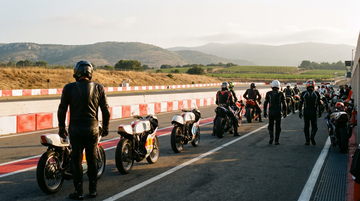
On track first, or on a road you know by heart and have genuinely scouted. There you know what’s waiting for you: the surface, the radius of every corner, no traffic coming the other way. That predictability is what makes full-on hanging off acceptable.
A track day is the ideal classroom: coaching on hand, the same corners lap after lap, and the freedom to get it wrong without paying for it. They aren’t hard to find, and our region-by-region rundown of motorcycle circuits will help you track down yours. On the gear side, a one-piece suit with knee sliders isn’t a gadget: the sliders are what let your knee touch the ground without any consequences for you.
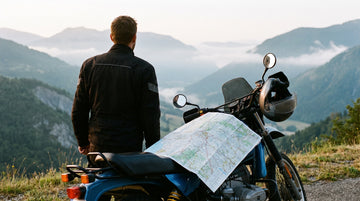
If you’d rather work on the road, do it methodically: pick a route, ride it at a calm pace to scout it, note the traps. That’s exactly how a road book works, and putting together a motorcycle road book gives you the method. To follow your progress from one session to the next, an app to record your motorcycle rides turns every ride into material you can analyze.
Where GeoRide fits in
Your knee is a lean sensor, and the GeoRide 3s GPS tracker is another one: it measures your lean angle every second through the corners and shows you, once the session is over, your average lean angle, your maximum, and how both changed around the lap. Enough to check your track progress with data instead of feel. A GPS tracker will never replace an advanced riding course, but it makes every session readable.
FAQ
Does getting your knee down make you faster?
No, the knee itself gains you nothing: it’s a lean reference, not a speed technique. What actually moves you forward is the body position that goes with it, hanging off with your chest toward the apex, because it keeps lean angle in hand on the same line.
Do you need a suit and knee sliders to get your knee down?
Yes, sliders are essential: they’re what slides on the tarmac instead of your knee. Without them, the contact chews up your gear and can unsettle you. A suit made for track use is the logical other half of the exercise.
Can you learn to get your knee down on the open road?
Not on a road picked at random: you learn this on track, or at a push on a route you know by heart and have scouted. On the open road, the position robs you of your view of the corner exit and of any margin to correct when something unexpected shows up.
Why do police motorcycle riders never get a knee down?
Because they deliberately stay upright on the bike, ready to pick it up at any moment. Their working environment is unpredictable, and their priority is the ability to react, not corner speed. It’s the exact opposite of the track logic behind hanging off.
À lire ensuite