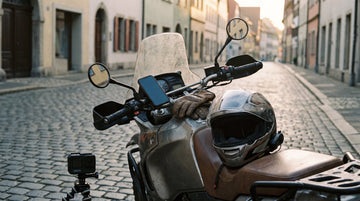

Connected screens on a motorcycle: the impact on rider safety
Protect my motorcycle with GeoRide Par Thomas
A connected screen can make you safer on a motorcycle or a lot less safe: it all comes down to where the information shows up and what it asks of you while you ride. The less time your eyes spend off the road, the better. The safest setups put the bare minimum in your line of sight, or better still, work away in the background without asking for a single glance.
The essentials
- The screen itself is not the problem: the problem is eyes off the road and attention pulled in two directions.
- A head-up display keeps visual distraction down; a phone you fiddle with on the handlebars sends it through the roof.
- The habit that works: set everything up before you pull away, then leave it alone until your next stop.
- The safest tech watches over things in the background: alerts, fall detection, location, with no screen to keep an eye on.
Are connected screens dangerous for riders?
They are, the moment they ask for your eyes or your hands while the bike is moving. On a motorcycle, every look at a screen is a look you are not giving the road, and the dangerous stuff happens in a split second: a car pulling out, a patch of gravel, brake lights right in front of you. With no bodywork and no seatbelt around you, a rider pays for a lapse of attention far more dearly than a driver does.
Researchers split distraction in two. Visual distraction comes first: checking a map, reading a notification, double-checking a route. Cognitive distraction is the sneaky one: even with your eyes on the road, a conversation or anything that taxes your brain cuts down how well you can read what is coming. Both pile up when your phone sits front and center on the bars with every notification switched on.
And the obvious point: handling your phone in your hand while riding is against the law, on a motorcycle as much as in a car. So the question is not whether to embrace tech or turn your back on it, but which tech protects your attention instead of eating it. Same reflex as with the rest of your gear: one more item for your motorcycle safety checklist before every ride.
Head-up display, handlebar screen, smartphone: what is the difference?
The closer the information sits to your line of sight, and the more it has been filtered down, the less it pulls you away. That is the whole gap between a head-up display built into the helmet, a dedicated GPS screen clamped to the bars, and a smartphone that gets everything, all the time.

| Solution | Where your eyes go | Distraction risk | How to use it right |
|---|---|---|---|
| Head-up display (smart helmet) | The information is projected into your field of view, your eyes stay on the road | Low, as long as it sticks to the essentials (direction, speed) | Stripped-back navigation, the odd alert |
| Dedicated GPS screen on the bars | A glance down, same as at the dash | Moderate: no stray notifications, but your eyes leave the road | Route set before you leave, checked at stops |
| Smartphone on a mount | Eyes down, on a busy screen that keeps changing | High: calls, messages and notifications land while you ride | Riding mode on, notifications off, hands off |
| Background tech (connected GPS tracker) | No glance needed while riding | None: nothing to check on the move | Protection, alerts and ride recording, all automatic |
A head-up display has one real advantage: it kills the back-and-forth between road and handlebars. It is no magic fix, though: an overloaded display sitting in your field of view becomes a nuisance of its own. The best designed smart helmets have understood this and only show what matters, when it matters.
How can you use connectivity without taking your eyes off the road?
By sorting everything out before you pull away, then giving the road every bit of your attention. Distraction rarely comes from the navigation itself: it comes from the tweaks you make on the move, from the message you read "just for a second", from the notification you were not expecting.
A few simple habits change everything:
- Start your route before you turn the key. Once you are rolling, follow the directions by ear or with a quick glance, never by touching the screen.
- Turn on a riding mode. Calls declined automatically, messages muted: anything that matters can wait for the next stop.
- Sort out your notifications. On the move, only riding information earns the right to exist. The rest is noise.
- Go for voice or handlebar controls. Hands stay on the grips, eyes stay on your line.
- Check things at stops. One proper look at every break beats ten micro-glances per kilometer.
Your kit matters too: a badly mounted phone that buzzes or swivels grabs your eye non-stop. Before you kit out your bars, have a look at the mistakes to avoid with a motorcycle phone mount. And if the road ahead is long, remember that distraction is not the only enemy of attention: fatigue on a motorcycle needs managing as well.
What if the best tech was the kind you never look at?
The safest tech on a motorcycle is the kind that asks nothing of you while you ride: it watches, it keeps an eye out, and it only speaks up when something really happens. That is exactly the thinking GeoRide was born from.
"It drove me mad that we were using sound to warn people about a problem, when we all have a phone in our pocket." Thomas Chambon, GeoRide founder
The whole logic is flipped compared with a screen you have to watch: the information comes to you, and only when it is worth something. A suspicious knock on your parked motorcycle? The GPS tracker fires off the alert straight away, as a push notification, by email, by phone call, or as an iOS critical alert that rings at full volume even in Do Not Disturb. Nothing to open, nothing to check: as long as your phone stays quiet, everything is fine.
Same story in a crash. The device picks up a fall while riding through its sensors and, if you do not answer, calls the emergency services on its own in under 2 minutes, and to the right people: the motorway control room on a motorway, the tunnel crew in a tunnel, the fire or ambulance service anywhere else (in mainland France). All of it works independently of your phone, even if the phone is smashed or dead after the fall.
And on the fun side, the same discretion: your rides are recorded automatically. Nothing to start, nothing to keep an eye on; the ride, the weather, the altitude and the route on the map are all waiting in the app once the bike is parked, along with the 3D ride replay. The tech does the recording while you get on with riding.
51.7%
That is the share of theft attempts where the GeoRide alert was enough on its own: the motorcycle was not even moved, according to the 2026 GeoRide Motorcycle Theft Report for France.

Where GeoRide fits in
GeoRide follows this invisible-tech principle to the letter: a discreet device, a GeoRide 3s or a GeoRide mini, wires into your bike's battery in 5 minutes, then drops out of sight. GPS tracker, smart alarm, fall detection: it all runs in the background, with nothing to interact with while you ride.
Location is in another league from traditional trackers: where a standard GPS tracking device sends one position every 5 minutes, GeoRide sends up to 10 positions per second through corners, with accuracy down below a meter thanks to Galileo. That is what separates a GPS tracker you have to poll from protection that acts. To pick between the two devices, our GeoRide mini or GeoRide 3s comparison lays out what each one can do.
"The point of GeoRide is to act in an emergency, and to leave you at ease the rest of the time." Thomas Chambon, GeoRide founder
Maybe that is the real impact of connected screens on rider safety: pick the right ones and they make the screen pointless while you ride. Eyes on the road, tracker on watch, and the app to tell you the story of the ride once the helmet is off.
Frequently asked questions
Are connected screens allowed on a motorcycle?
Yes, a GPS unit or a smartphone on a mount is fine, as long as you do not handle it while riding. Holding your phone in your hand at the controls is illegal and punished, on a motorcycle as much as in a car. The common-sense rule: set everything up while stopped, and on the move give the screen a glance, never more than that.
Is a head-up display safer than a smartphone on the handlebars?
Yes, for the same use, because the information appears in your field of view and your eyes stay on the road. A smartphone on the bars forces you to look down and brings its share of stray notifications. A head-up display still needs setting up sparingly, though: too much information floating in front of your eye turns back into a distraction.
Is GeoRide distracting while you ride?
No, GeoRide asks nothing of you on the move: it all runs in the background. Ride recording is automatic, theft alerts are about the parked motorcycle, and fall detection acts on its own if you do not answer. You look at the app before or after the ride, never during.
What happens in a fall if my phone is smashed?
The emergency services are alerted anyway: the GeoRide device works independently of your phone, even if it is switched off or destroyed in the fall. Its sensors pick up the impact and, if you do not answer, the emergency services are called automatically in under 2 minutes in mainland France, with your exact position.
À lire ensuite